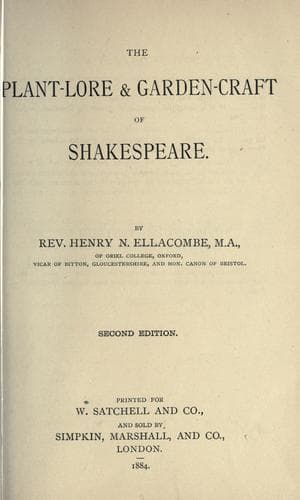
The plant-lore & garden-craft of ShakespeareEllacombe, Henry Nicholson
General
The plant-lore & garden-craft of Shakespeare
Ellacombe, Henry Nicholson
Gardens in literature; Plants in literature; Shakespeare, William, 1564-1616 -- Knowledge -- Botany
The Strawberry is among fruits what the Primrose and Snowdrop are among
flowers, the harbinger of other good fruits to follow. It is the
earliest of the summer fruits, and there is no need to dwell on its
delicate, sweet-scented freshness, so acceptable to all; but it has also
a charm in autumn, known, however, but to few, and sometimes said to be
only discernible by few. Among "the flowers that yield sweetest smell in
the air," Lord Bacon reckoned Violets, and "next to that is the Musk
Rose, then the Strawberry leaves dying, with a most excellent cordial
smell." In Mrs. Gaskell's pretty tale, "My Lady Ludlow," the dying
Strawberry leaves act an important part. "The great hereditary faculty
on which my lady piqued herself, and with reason, for I never met with
any other person who possessed it, was the power she had of perceiving
the delicious odour arising from a bed of Strawberry leaves in the late
autumn, when the leaves were all fading and dying." The old lady quotes
Lord Bacon, and then says: "'Now the Hanburys can always smell the
excellent cordial odour, and very delicious and refreshing it is. In the
time of Queen Elizabeth the great old families of England were a
distinct race, just as a cart-horse is one creature and very useful in
its place, and Childers or Eclipse is another creature, though both are
of the same species. So the old families have gifts and powers of a
different and higher class to what the other orders have. My dear,
remember that you try and smell the scent of dying Strawberry leaves in
this next autumn, you have some of Ursula Hanbury's blood in you, and
that gives you a chance.' 'But when October came I sniffed, and sniffed,
and all to no purpose; and my lady, who had watched the little
experiment rather anxiously, had to give me up as a hybrid'" ("Household
Words," vol. xviii.). On this I can only say in the words of an old
writer, "A rare and notable thing, if it be true, for I never proved it,
and never tried it; therefore, as it proves so, praise it."[282:1]
Spenser also mentions the scent, but not of the leaves or fruit, but of
the flowers--
"Comming to kisse her lyps (such grace I found),
Me seem'd I smelt a garden of sweet flowres
That dainty odours from them threw around:
* * * * *
Her goodly bosome, lyke a Strawberry bed,
* * * * *
Such fragrant flowres doe give most odorous smell."[282:2]
_Sonnet_ lxiv.
There is a considerable interest connected with the name of the plant,
and much popular error. It is supposed to be called Strawberry because
the berries have straw laid under them, or from an old custom of selling
the wild ones strung on straws.[282:3] In Shakespeare's time straw was
used for the protection of Strawberries, but not in the present
fashion--
Public-domain text, read in full here on John Shaqi.
Reviews
Reviews
No reviews yet
Be the first to share your thoughts on this work.
Elsewhere in the archive
Join the Discussion
Join the discussion
Sign in to leave a comment or review.
Sign InorCreate an account