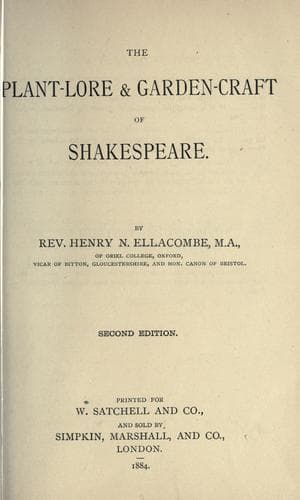
The plant-lore & garden-craft of ShakespeareEllacombe, Henry Nicholson
General
The plant-lore & garden-craft of Shakespeare
Ellacombe, Henry Nicholson
Gardens in literature; Plants in literature; Shakespeare, William, 1564-1616 -- Knowledge -- Botany
We are oft to blame in this--
Tis too much proved--that with devotion's visage
And pious actions we do Sugar o'er
The devil himself.
_Hamlet_, act iii, sc. 1 (46).
(12) _Brabantio._
These sentences, to Sugar, or to gall,
Being strong on both sides, are equivocal.
_Othello_, act i, sc. 3 (216).
(13) _Timon._
And never learn'd
The icy precepts of respect, but follow'd
The Sugar'd game before thee.
_Timon of Athens_, act iv, sc. 3 (257).
(14) _Pucelle._
By fair persuasion mix'd with Sugar'd words
We will entice the Duke of Burgundy.
_1st Henry VI_, act iii, sc. 3 (18).
(15) _K. Henry._
Hide not thy poison with such Sugar'd words.
_2nd Henry VI_, act iii, sc. 2 (45).
(16) _Prince Henry._
One poor pennyworth of Sugar-candy, to make thee long-winded.
_1st Henry IV_, act iii, sc. 3 (180).
(17)
Thy Sugar'd tongue to bitter Wormwood taste.
_Lucrece_ (893).
As a pure vegetable product, though manufactured, Sugar cannot be passed
over in an account of the plants of Shakespeare; but it will not be
necessary to say much about it. Yet the history of the migrations of the
Sugar-plant is sufficiently interesting to call for a short notice.
Its original home seems to have been in the East Indies, whence it was
imported in very early times. It is probably the "sweet cane" of the
Bible; and among classical writers it is named by Strabo, Lucan, Varro,
Seneca, Dioscorides, and Pliny. The plant is said to have been
introduced into Europe during the Crusades, and to have been cultivated
in the Morea, Rhodes, Malta, Sicily, and Spain.[286:1] By the Spaniards
it was taken first to Madeira and the Cape de Verd Islands, and, very
soon after the discovery of America, to the West Indies. There it soon
grew rapidly, and increased enormously, and became a chief article of
commerce, so that though we now almost look upon it as entirely a New
World plant, it is in fact but a stranger there, that has found a most
congenial home.
In 1468 the price of Sugar was sixpence a pound, equal to six shillings
of our money,[287:1] but in Shakespeare's time it must have been very
common,[287:2] or it could not so largely have worked its way into the
common English language and proverbial expressions; and it must also
have been very cheap, or it could not so entirely have superseded the
use of honey, which in earlier times was the only sweetening material.
Public-domain text, read in full here on John Shaqi.
Reviews
Reviews
No reviews yet
Be the first to share your thoughts on this work.
Elsewhere in the archive
Join the Discussion
Join the discussion
Sign in to leave a comment or review.
Sign InorCreate an account