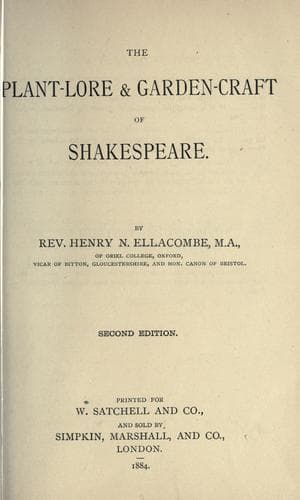
The plant-lore & garden-craft of ShakespeareEllacombe, Henry Nicholson
General
The plant-lore & garden-craft of Shakespeare
Ellacombe, Henry Nicholson
Gardens in literature; Plants in literature; Shakespeare, William, 1564-1616 -- Knowledge -- Botany
Shakespeare may have seen the living plant, for it was grown as a
curiosity in his day, though Gerard could not succeed with it: "Myself
did plant some shootes thereof in my garden, and some in Flanders did
the like, but the coldness of our clymate made an end of myne, and I
think the Flemmings will have the like profit of their labour." But he
bears testimony to the large use of Sugar in his day; "of the juice of
the reede is made the most pleasant and profitable sweet called Sugar,
whereof is made infinite confections, sirupes, and such like, as also
preserving and conserving of sundrie fruits, herbes and flowers, as
roses, violets, rosemary flowers and such like."
FOOTNOTES:
[286:1] "It is the juice of certain canes or reedes whiche growe most
plentifully in the Ilandes of Madera, Sicilia, Cyprus, Rhodus and Candy.
It is made by art in boyling of the Canes, much like as they make their
white salt in the Witches in Cheshire."--COGHAN, _Haven of Health_,
1596, p. 110.
[287:1] "Babee's Book," xxx.
[287:2] It is mentioned by Chaucer--
"Gyngerbred that was so fyn.
And licorys and eek comyn
With Sugre that is trye."--_Tale of Sir Thopas._
SWEET MARJORAM, _see_ MARJORAM.
SYCAMORE.
(1) _Desdemona_ (singing).
The poor soul sat sighing by a Sycamore tree.
_Othello_, act iv, sc. 3 (41).
(2) _Benvolio._
Underneath the grove of Sycamore
That westward rooteth from the city's side,
So early walking did I see your son.
_Romeo and Juliet_, act i, sc. 1 (130).
(3) _Boyet._
Under the cool shade of a Sycamore
I thought to close mine eyes some half an hour.
_Love's Labour's Lost_, act v, sc. 2 (89).
In its botanical relationship, the Sycamore is closely allied to the
Maple, and was often called the Great Maple, and is still so called in
Scotland. It is not indigenous in Great Britain, but it has long been
naturalized among us, and has taken so kindly to our soil and climate
that it is one of our commonest trees. It is one of the best of forest
trees for resisting wind; it "scorns to be biassed in its mode of growth
even by the prevailing wind, but shooting its branches with equal
boldness in every direction, shows no weatherside to the storm, and may
be broken, but never can be bended."-_Old Mortality_, c. i.
Public-domain text, read in full here on John Shaqi.
Reviews
Reviews
No reviews yet
Be the first to share your thoughts on this work.
Elsewhere in the archive
Join the Discussion
Join the discussion
Sign in to leave a comment or review.
Sign InorCreate an account