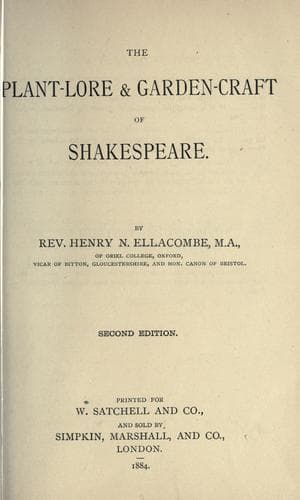
The plant-lore & garden-craft of ShakespeareEllacombe, Henry Nicholson
General
The plant-lore & garden-craft of Shakespeare
Ellacombe, Henry Nicholson
Gardens in literature; Plants in literature; Shakespeare, William, 1564-1616 -- Knowledge -- Botany
But it is owing to these pretty Thistledowns that the plant becomes a
most undesirable neighbour, for they carry the seed everywhere, and
wherever it is carried, it soon vegetates, and a fine crop of Thistles
very quickly follows. In this way, if left to themselves, the Thistles
will soon monopolize a large extent of country, to the extinction of
other plants, as they have done in parts of the American prairies, and
as they did in Australia, till a most stringent Act of Parliament was
passed about twenty years ago, imposing heavy penalties upon all who
neglected to destroy the Thistles on their land. For these reasons we
cannot admit the Thistle into the garden, at least not our native
Thistles; but there are some foreigners which may well be admitted.
There are the handsome yellow Thistles of the South of Europe
(_Scolymus_), which besides their beauty have a classical interest.
"Hesiod elegantly describing the time of year, says,
ἠμος δε σκολυμος τ'ανθει,
when the Scolymus flowers, _i.e._, in hot weather or summer ("Op. et
dies," 582). This plant crowned with its golden flowers is abundant
throughout Sicily."--HOGG'S _Classical Plants of Sicily_. There is the
Fish-bone Thistle (_Chamæpeuce diacantha_) from Syria, a very handsome
plant, and, like most of the Thistles, a biennial; but if allowed to
flower and go to seed, it will produce plenty of seedlings for a
succession of years. And there is a grand scarlet Thistle from Mexico,
the Erythrolena conspicua ("Sweet," vol. ii. p. 134), which must be
almost the handsomest of the family, and which was grown in England
fifty years ago, but has been long lost. There are many others that may
deserve a place as ornamental plants, but they find little favour, for
"they are only Thistles."
Any notice of the Thistle would be imperfect without some mention of the
Scotch Thistle. It is the one point in the history of the plant that
protects it from contempt. We dare not despise a plant which is the
honoured badge of our neighbours and relations, the Scotch; which is
ennobled as the symbol of the Order of the Thistle, that claims to be
the most ancient of all our Orders of high honour; and which defies you
to insult it or despise it by its proud mottoes, "Nemo me impune
lacessit," "Ce que Dieu garde, est bien gardé." What is the true Scotch
Thistle even the Scotch antiquarians cannot decide, and in the
uncertainty it is perhaps safest to say that no Thistle in particular
can claim the sole honour, but that it extends to every member of the
family that can be found in Scotland.[292:1]
Public-domain text, read in full here on John Shaqi.
Reviews
Reviews
No reviews yet
Be the first to share your thoughts on this work.
Elsewhere in the archive
Join the Discussion
Join the discussion
Sign in to leave a comment or review.
Sign InorCreate an account