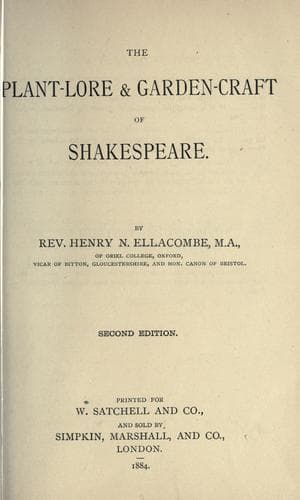
The plant-lore & garden-craft of ShakespeareEllacombe, Henry Nicholson
General
The plant-lore & garden-craft of Shakespeare
Ellacombe, Henry Nicholson
Gardens in literature; Plants in literature; Shakespeare, William, 1564-1616 -- Knowledge -- Botany
The wood of the Sycamore is useful for turning and a few other purposes,
but is not very durable. The sap, as in all the Maples, is full of
sugar, and the pollen is very curious; "it appears globular in the
microscope, but if it be touched with anything moist, the globules burst
open with four valves, and then they appear in the form of a
cross."--MILLER.
THISTLE (_see also_ HOLY THISTLE).
(1) _Burgundy._
And nothing teems
But hateful Docks, rough Thistles, Kecksies, Burs.
_Henry V_, act v, sc. 2 (51).
(2) _Bottom._
Mounsieur Cobweb, good mounsieur, get you your weapons ready
in your hand, and kill me a red-hipped humble bee on the top
of a Thistle; and, good mounsieur, bring me the honey-bag.
_Midsummer Night's Dream_, act iv, sc. 1 (10).
Thistle is the old English name for a large family of plants occurring
chiefly in Europe and Asia, of which we have fourteen species in Great
Britain, arranged under the botanical families of Carlina, Carduus, and
Onopordon. It is the recognized symbol of untidiness and carelessness,
being found not so much in barren ground as in good ground not properly
cared for. So good a proof of a rich soil does the Thistle give, that a
saying is attributed to a blind man who was choosing a piece of
land--"Take me to a Thistle;" and Tusser says--
"Much wetnes, hog-rooting, and land out of hart makes Thistles
a number foorthwith to upstart. If Thistles so growing proove
lustie and long, It signifieth land to be hartie and strong."
_October's Husbandry_ (13).
If the Thistles were not so common, and if we could get rid of the
associations they suggest, there are probably few of our wild plants
that we should more admire: they are stately in their foliage and habit,
and some of their flowers are rich in colour, and the Thistledown, which
carries the seed far and wide, is very beautiful, and was once
considered useful as a sign of rain, for "if the down flyeth off
Coltsfoot, Dandelyon, or Thistles when there is no winde, it is a signe
of rain."--COLES.
It had still another use in rustic divination--
"Upon the various earth's embroidered gown,
There is a weed upon whose head grows down,
Sow Thistle 'tis y'clept, whose downy wreath
If anyone can blow off at a breath
We deem her for a maid."--BROWNE'S _Brit. Past._, i, 4.
Public-domain text, read in full here on John Shaqi.
Reviews
Reviews
No reviews yet
Be the first to share your thoughts on this work.
Elsewhere in the archive
Join the Discussion
Join the discussion
Sign in to leave a comment or review.
Sign InorCreate an account