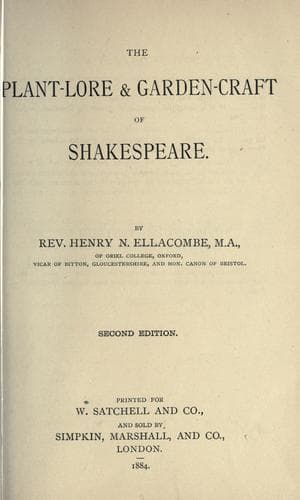
The plant-lore & garden-craft of ShakespeareEllacombe, Henry Nicholson
General
The plant-lore & garden-craft of Shakespeare
Ellacombe, Henry Nicholson
Gardens in literature; Plants in literature; Shakespeare, William, 1564-1616 -- Knowledge -- Botany
It is one of the most curious of the curiosities of English plant names
that the Wild Thyme--a plant so common and so widely distributed, and
that makes itself so easily known by its fine aromatic, pungent scent,
that it is almost impossible to pass it by without notice--has yet no
English name, and seems never to have had one. Thyme is the Anglicised
form of the Greek and Latin _Thymum_, which name it probably got from
its use for incense in sacrifices, while its other name of _serpyllum_
pointed out its creeping habit. I do not know when the word Thyme was
first introduced into the English language, for it is another curious
point connected with the name, that _thymum_ does not occur in the old
English vocabularies. We have in Ælfric's "Vocabulary," "Pollegia,
hyl-wyrt," which may perhaps be the Thyme, though it is generally
supposed to be the Pennyroyal; we have in a Vocabulary of thirteenth
century, "Epitime, epithimum, fordboh," which also may be the Wild
Thyme; we have in a Vocabulary of the fifteenth century, "Hoc sirpillum,
A{ce} petergrys;" and in a Pictorial Vocabulary of the same date, "Hoc
cirpillum, A{ce} a pellek" (which word is probably a misprint, for in
the "Promptorium Parvulorum," c. 1440, it is "Peletyr, herbe, _serpillum
piretrum_"), both of which are almost certainly the Wild Thyme; while in
an Anglo-Saxon Vocabulary of the tenth or eleventh century we have
"serpulum, crop-leac," _i.e._, the Onion, which must certainly be a
mistake of the compiler. So that not even in its Latin form does the
name occur, except in the "Promptorium Parvulorum," where it is "Tyme,
herbe, _Tima_, _Timum_--Tyme, floure, _Timus_;" and in the "Catholicon
Anglicum," when it is "Tyme; _timum epitimum; flos ejus est_." It is
thus a puzzle how it can have got naturalized among us, for in
Shakespeare's time it was completely naturalized.
I have already quoted Lord Bacon's account of it under BURNET, but I
must quote it again here: "Those flowers which perfume the air most
delightfully, not passed by as the rest, but being trodden upon and
crushed, are three--that is Burnet, Wild Thyme, and Water mints;
therefore you are to set whole alleys of them, to have the pleasure when
you walk or tread;" and again in his pleasant description of the heath
or wild garden, which he would have in every "prince-like garden," and
"framed as much as may be to a natural wildness," he says, "I like also
little heaps, in the nature of mole-hills (such as are in wild heaths)
to be set some with Wild Thyme, some with Pinks, some with Germander."
Yet the name may have been used sometimes as a general name for any
wild, strong-scented plant. It can only be in this sense that Milton
used it--
"Thee, shepherd! thee the woods and desert caves,
With Wild Thyme and the gadding Vine o'ergrown,
And all their echoes mourn."
_Lycidas._
Public-domain text, read in full here on John Shaqi.
Reviews
Reviews
No reviews yet
Be the first to share your thoughts on this work.
Elsewhere in the archive
Join the Discussion
Join the discussion
Sign in to leave a comment or review.
Sign InorCreate an account