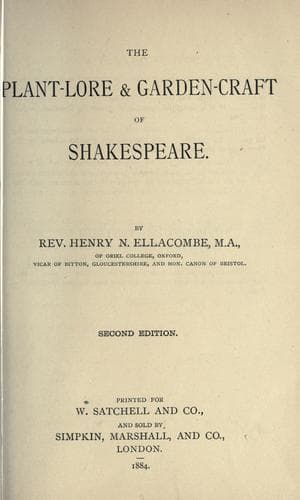
The plant-lore & garden-craft of ShakespeareEllacombe, Henry Nicholson
General
The plant-lore & garden-craft of Shakespeare
Ellacombe, Henry Nicholson
Gardens in literature; Plants in literature; Shakespeare, William, 1564-1616 -- Knowledge -- Botany
for certainly a desert cave is almost the last place in which we should
look for the true Wild Thyme.
It is as a bee-plant especially that the Thyme has always been
celebrated. Spenser speaks of it as "the bees alluring Tyme," and Ovid
says of it, speaking of Chloris or Flora--
"Mella meum munus; volucres ego mella daturos
Ad violam et cytisos, et Thyma cana voco."
_Fasti_, v.
so that the Thyme became proverbial as the symbol of sweetness. It was
the highest compliment that the shepherd could pay to his mistress--
"Nerine Galatea, Thymo mihi dulcior Hyblæ."
VIRGIL, _Ecl._ vii.
And it was because of its wild Thyme that Mount Hymettus became so
celebrated for its honey--"Mella Thymi redolentia flore" (Ovid). "Thyme,
for the time it lasteth, yeeldeth most and best honni, and therefore in
old time was accounted chief (Thymus aptissimus ad mellificum--Pastus
gratissimus apibus Thymum est--Plinii, 'His. Nat.')
'Dum thymo pascentur apes, dum rore cicadæ.'
VIRGIL, _Georg._
Hymettus in Greece and Hybla in Sicily were so famous for Bees and
Honni, because there grew such store of Tyme; propter hoc Siculum mel
fert palmam, quod ibi Thymum bonum et frequens est."--VARRO, _The
Feminine Monarchie_, 1634.
The Wild Thyme can scarcely be considered a garden plant, except in its
variegated and golden varieties, which are very handsome, but if it
should ever come naturally in the turf, it should be welcomed and
cherished for its sweet scent. The garden Thyme (_T. vulgaris_) must of
course be in every herb garden; and there are a few species which make
good plants for the rockwork, such as T. lanceolatus from Greece, a very
low-growing shrub, with narrow, pointed leaves; T. carnosus, which makes
a pretty little shrub, and others; while the Corsican Thyme (_Mentha
Requieni_) is perhaps the lowest and closest-growing of all herbs,
making a dark-green covering to the soil, and having a very strong
scent, though more resembling Peppermint than Thyme.
TOADSTOOLS, _see_ MUSHROOMS.
TURNIPS.
_Anne._
Alas! I had rather be set quick i' the earth
And boul'd to death with Turnips.
_Merry Wives of Windsor_, act iii, sc. 4 (89).
Public-domain text, read in full here on John Shaqi.
Reviews
Reviews
No reviews yet
Be the first to share your thoughts on this work.
Elsewhere in the archive
Join the Discussion
Join the discussion
Sign in to leave a comment or review.
Sign InorCreate an account