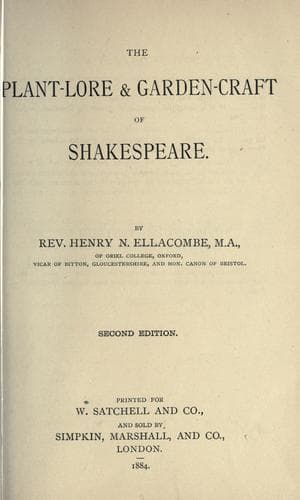
The plant-lore & garden-craft of ShakespeareEllacombe, Henry Nicholson
General
The plant-lore & garden-craft of Shakespeare
Ellacombe, Henry Nicholson
Gardens in literature; Plants in literature; Shakespeare, William, 1564-1616 -- Knowledge -- Botany
The cultivated Vetch (_Vicia sativa_) is probably not a British plant,
and it is not very certain to what country it rightly belongs; but it
was very probably introduced into England by the Romans as an excellent
and easily-grown fodder-plant. There are several Vetches that are true
British plants, and they are among the most beautiful ornaments of our
lanes and hedges. Two especially deserve to take a place in the garden
for their beauty; but they require watching, or they will scramble into
parts where their presence is not desirable; these are V. cracca and V.
sylvatica. V. cracca has a very bright pure blue flower, and may be
allowed to scramble over low bushes; V. sylvatica is a tall climber, and
may be seen in copses and high hedges climbing to the tops of the Hazels
and other tall bushes. It is one of the most graceful of our British
plants, and perhaps quite the most graceful of our climbers; it bears an
abundance of flowers, which are pure white streaked and spotted with
pale blue; it is not a very common plant, but I have often seen it in
Gloucestershire and Somersetshire, and wherever it is found it is
generally in abundance.
The other name for the Vetch is Tares, which is, no doubt, an old
English word that has never been satisfactorily explained. The word has
an interest from its biblical associations, though modern scholars
decide that the Zizania is wrongly translated Tares, and that it is
rather a bastard Wheat or Darnel.
VINES.
(1) _Titania._
Feed him with Apricocks and Dewberries,
With purple Grapes, green Figs, and Mulberries.
_Midsummer Night's Dream_, act iii, sc. 1 (169).
(2) _Menenius._
The tartness of his face sours ripe Grapes.
_Coriolanus_, act v, sc. 4 (18).
(3) _Song._
Come, thou monarch of the Vine,
Plumpy Bacchus, with pink eyne!
In thy fats our cares be drown'd,
With thy Grapes our hairs be crown'd.
_Antony and Cleopatra_, act ii, sc. 7 (120).
(4) _Cleopatra._
Now no more
The juice of Egypt's Grape shall moist this lip.
_Ibid._, act v, sc. 2 (284).
(5) _Timon._
Dry up thy Marrows, Vines, and plough-torn leas.
_Timon of Athens_, act iv, sc. 3 (193).
(6) _Timon._
Go, suck the subtle blood o' the Grape,
Till the high fever seethe your blood to froth.
_Ibid._ (432).
(7) _Touchstone._
The heathen philosopher, when he had a desire to eat a Grape,
would open his lips when he put it into his mouth; meaning
thereby that Grapes were made to eat and lips to open.
_As You Like It_, act v, sc. 1 (36).
(8) _Iago._
Blessed Fig's end! the wine she drinks is made of Grapes.
_Othello_, act ii, sc 1 (250).
Public-domain text, read in full here on John Shaqi.
Reviews
Reviews
No reviews yet
Be the first to share your thoughts on this work.
Elsewhere in the archive
Join the Discussion
Join the discussion
Sign in to leave a comment or review.
Sign InorCreate an account