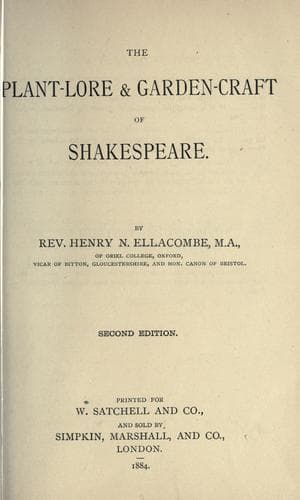
The plant-lore & garden-craft of ShakespeareEllacombe, Henry Nicholson
General
The plant-lore & garden-craft of Shakespeare
Ellacombe, Henry Nicholson
Gardens in literature; Plants in literature; Shakespeare, William, 1564-1616 -- Knowledge -- Botany
The Turnips of Shakespeare's time were like ours, and probably as good,
though their cultivation seems to have been chiefly confined to gardens.
It is not very certain whether the cultivated Turnip is the wild Turnip
improved in England by cultivation, or whether we are indebted for it to
the Romans, and that the wild one is only the degenerate form of the
cultivated plant; for though the wild Turnip is admitted into the
English flora, yet its right to the admission is very doubtful. But if
we did not get the vegetable from the Romans we got its name. The old
name for it was _nœp_, _nep_, or _neps_, which was only the English
form of the Latin _napus_, while Turnip is the corruption of _terræ
napus_, but when the first syllable was added I do not know. There is a
curious perversion in the name, for our Turnip is botanically Brassica
rapa, while the Rape is Brassica napus, so that the English and Latin
have changed places, the Napus becoming a Rape and the Rapa a Nep.
The present large field cultivation of Turnips is of comparatively a
modern date, though the field Turnip and garden Turnip are only
varieties of the same species, while there are also many varieties both
of the field and garden Turnip. "One field proclaims the Scotch variety,
while the bluer cast tells its hardy Swedish origin; the tankard
proclaims a deep soil, and the lover of boiled mutton, rejoicing, sees
the yellower tint of the Dutch or Stone Turnip, which he desires to meet
with again in the market."--PHILLIPS.
It is not very easy to speak of the moral qualities of Turnips, or to
make them the symbols of much virtue, yet Gwillim did so: "He beareth
sable, a Turnip proper, a chief or gutte de Larmes. This is a wholesome
root, and yieldeth great relief to the poor, and prospereth best in a
hot sandy ground, and may signifie a person of good disposition, whose
vertuous demeanour flourisheth most prosperously, even in that soil,
where the searching heat of envy most aboundeth. This differeth much in
nature from that whereof it is said, 'And that there should not be among
you any root that bringeth forth gall and wormwood.'"--GWILLIM'S
_Heraldry_, sec. iii. c. 11.
VETCHES.
_Iris._
Ceres, most bounteous lady, thy rich leas,
Of Wheat, Rye, Barley, Vetches, Oats, and Pease.
_Tempest_, act iv, sc. 1 (60).
Public-domain text, read in full here on John Shaqi.
Reviews
Reviews
No reviews yet
Be the first to share your thoughts on this work.
Elsewhere in the archive
Join the Discussion
Join the discussion
Sign in to leave a comment or review.
Sign InorCreate an account