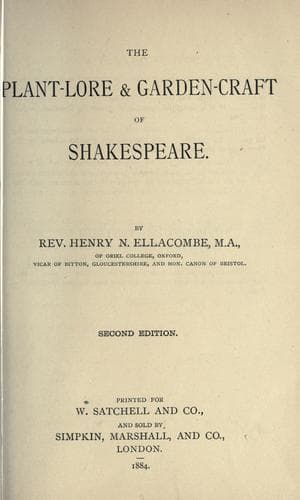
The plant-lore & garden-craft of ShakespeareEllacombe, Henry Nicholson
General
The plant-lore & garden-craft of Shakespeare
Ellacombe, Henry Nicholson
Gardens in literature; Plants in literature; Shakespeare, William, 1564-1616 -- Knowledge -- Botany
(24) _Isabella._
He hath a garden circummured with brick,
Whose western side is with a Vineyard back'd;
And to that Vineyard is a planched gate,
That makes his opening with this bigger key:
This other doth command a little door,
Which from the Vineyard to the garden leads.
_Measure for Measure_, act iv, sc. 1 (28).
(25)
The Vine shall grow, but we shall never see it.
_Two Noble Kinsmen_, act ii, sc. 2 (47).
(26)
Even as poor birds, deceived with painted Grapes,
Do forfeit by the eye and pine the maw.
_Venus and Adonis_ (601).
(27)
For one sweet Grape, who will the Vine destroy?
_Lucrece_ (215).
Besides these different references to the Grape Vine, some of its
various products are mentioned, as Raisins, wine, aquavitæ or brandy,
claret (the "thin potations" forsworn by Falstaff), sherris-sack or
sherry, and malmsey. But none of these passages gives us much insight
into the culture of the Vine in England, the whole history of which is
curious and interesting.
The Vine is not even a native of Europe, but of the East, whence it was
very early introduced into Europe; so early, indeed, that it has
recently been found "fossil in a tufaceous deposit in the South of
France."--DARWIN. It was no doubt brought into England by the Romans.
Tacitus, describing England in the first century after Christ, says
expressly that the Vine did not, and, as he evidently thought, could not
grow there. "Solum, præter oleam vitemque et cætera calidioribus terris
oriri sueta, patiens frugum, fæcundum." Yet Bede, writing in the eighth
century, describes England as "opima frugibus atque arboribus insula, et
alendis apta pecoribus et jumentis Vineas etiam quibusdam in locis
germinans."[301:1]
Public-domain text, read in full here on John Shaqi.
Reviews
Reviews
No reviews yet
Be the first to share your thoughts on this work.
Elsewhere in the archive
Join the Discussion
Join the discussion
Sign in to leave a comment or review.
Sign InorCreate an account