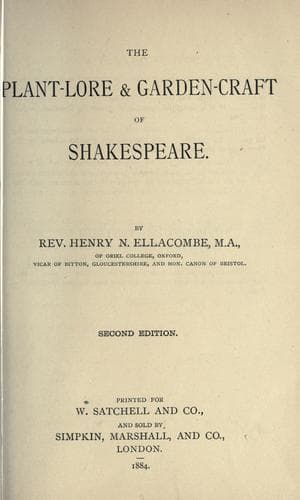
The plant-lore & garden-craft of ShakespeareEllacombe, Henry Nicholson
General
The plant-lore & garden-craft of Shakespeare
Ellacombe, Henry Nicholson
Gardens in literature; Plants in literature; Shakespeare, William, 1564-1616 -- Knowledge -- Botany
From that time till the time of Shakespeare there is abundant proof not
only of the growth of the Vine as we now grow it in gardens, but in
large Vineyards. In Anglo-Saxon times "a Vineyard" is not unfrequently
mentioned in various documents. "Edgar gives the Vineyard situated at
Wecet, with the Vine-dressers."--TURNER'S _Anglo-Saxons_. "'Domesday
Book' contained thirty-eight entries of valuable Vineyards; one in Essex
consisted of six acres, and yielded twenty hogsheads of wine in a good
year. There was another of the same extent at Ware."--H. EVERSHED, in
_Gardener's Chronicle_. So in the Norman times, "Giraldus Cambrensis,
speaking of the Castle of Manorbeer (his birthplace), near Pembroke,
said that it had under its walls, besides a fishpond, a beautiful
garden, enclosed on one side by a Vineyard and on the other by a wood,
remarkable for the projection of its rocks and the height of its Hazel
trees. In the twelfth century Vineyards were not uncommon in
England."--WRIGHT. Neckam, writing in that century, refers to the
usefulness of the Vine when trained against the wall-front: "Pampinus
latitudine suâ excipit æris insultus, cum res ita desiderat, et fenestra
clementiam caloris solaris admittat."--HUDSON TURNER.
In the time of Shakespeare I suppose that most of the Vines in England
were grown in Vineyards of more or less extent, trained to poles. These
formed the "pole-clipt Vineyards" of No. 21, and are thus described by
Gerard: "The Vine is held up with poles and frames of wood, and by that
means it spreadeth all about and climbeth aloft; it joyneth itselfe unto
trees, or whatsoever standeth next unto it"--in other words, the Vine
was then chiefly grown as a standard in the open ground.
There are numberless notices in the records and chronicles of extensive
vineyards in England, which it is needless to quote; but it is worth
noticing that the memory of these Vineyards remains not only in the
chronicles and in the treatises which teach of Vine-culture, but also in
the names of streets, &c., which are occasionally met with. There is
"Vineyard Holm," in the Hampshire Downs, and many other places in
Hampshire; the "Vineyard Hills," at Godalming; the "Vines," at Rochester
and Sevenoaks; the "Vineyards," at Bath and Ludlow; the "Vine Fields,"
near the Abbey at Bury St. Edmunds;[302:1] the "Vineyard Walk" in
Clerkenwell; and "near Basingstoke the 'Vine' or 'Vine House,' in a
richly wooded spot, where, as is said, the Romans grew the first Vine in
Britain, the memory of which now only survives in the Vine
Hounds;"[303:1] and probably a closer search among the names of fields
in other parts would bring to light many similar instances.[303:2]
Public-domain text, read in full here on John Shaqi.
Reviews
Reviews
No reviews yet
Be the first to share your thoughts on this work.
Elsewhere in the archive
Join the Discussion
Join the discussion
Sign in to leave a comment or review.
Sign InorCreate an account