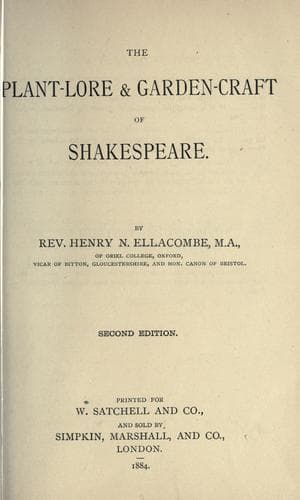
The plant-lore & garden-craft of ShakespeareEllacombe, Henry Nicholson
General
The plant-lore & garden-craft of Shakespeare
Ellacombe, Henry Nicholson
Gardens in literature; Plants in literature; Shakespeare, William, 1564-1616 -- Knowledge -- Botany
Among the English Vineyards those of Gloucestershire stood pre-eminent.
William of Malmesbury, writing of Gloucestershire in the twelfth
century, says: "This county is planted thicker with Vineyards than any
other in England, more plentiful in crops, and more pleasant in flavour.
For the wines do not offend the mouth with sharpness, since they do not
yield to the French in sweetness" ("De Gestis Pontif.," book iv.) Of
these Vineyards the tradition still remains in the county. The Cotswold
Hills are in many places curiously marked with a succession of steps or
narrow terraces, called "litchets" or "lynches;" these are traditionally
the sites of the old Vineyards, but the tradition cannot be fully
depended on, and the formation of the terraces has been variously
accounted for. By some they are supposed to be natural formations, but
wherever I have seen them they appear to me too regular and artificial;
nor, as far as I am aware, does the oolite, on which formation these
terraces mostly occur, take the form of a succession of narrow terraces.
It seems certain that the ground was artificially formed into these
terraces with very little labour, and that they were utilized for some
special cultivation, and as likely for Vines as for any other.[303:3] It
is also certain that as the Gloucestershire Vineyards were among the
most ancient and the best in England, so they held their ground till
within a very recent period. I cannot find the exact date, but some time
during the last century there is "satisfactory testimony of the full
success of a plantation in Cromhall Park, from which ten hogsheads of
wine were made in the year. The Vine plantation was discontinued or
destroyed in consequence of a dispute with the Rector on a claim of the
tythes."--RUDGE'S _History of Gloucestershire_. This, however, is not
quite the latest notice I have met with, for Phillips, writing in 1820,
says: "There are several flourishing Vineyards at this time in
Somersetshire; the late Sir William Basset, in that county, annually
made some hogsheads of wine, which was palatable and well-bodied. The
idea that we cannot make good wine from our own Grapes is erroneous; I
have tasted it quite equal to the Grave wines, and in some instances,
when kept for eight or ten years, it has been drunk as hock by the
nicest judges."--_Pomarium Britannicum._ It would have been more
satisfactory if Mr. Phillips had told us the exact locality of any of
these "flourishing Vineyards," for I can nowhere else find any account
of them, except that in a map of five miles round Bath in 1801 a
Vineyard is marked at Claverton, formerly in the possession of the
Bassets, and the Vines are distinctly shown.[304:1] At present the
experiment is again being tried by the Marquis of Bute, at Castle Coch,
near Cardiff, to establish a Vineyard, not to produce fruit for the
market, but to produce wine; and as both soil and climate seem very
suitable, there can be little doubt that wine will be produced of a very
Public-domain text, read in full here on John Shaqi.
Reviews
Reviews
No reviews yet
Be the first to share your thoughts on this work.
Elsewhere in the archive
Join the Discussion
Join the discussion
Sign in to leave a comment or review.
Sign InorCreate an account