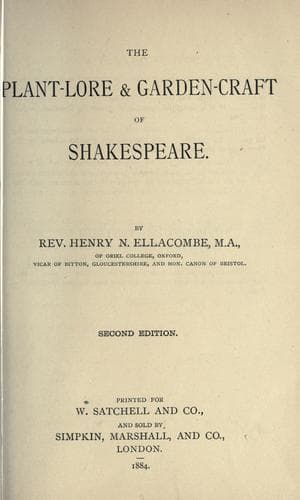
The plant-lore & garden-craft of ShakespeareEllacombe, Henry Nicholson
General
The plant-lore & garden-craft of Shakespeare
Ellacombe, Henry Nicholson
Gardens in literature; Plants in literature; Shakespeare, William, 1564-1616 -- Knowledge -- Botany
Yet favourite though it ever has been, it has no English name. Violet is
the diminutive form of the Latin Viola, which again is the Latin form
of the Greek ἴον. In the old Vocabularies Viola frequently occurs, and
with the following various translations:--"Ban-wyrt," _i.e._, Bone-wort
(eleventh century Vocabulary); "Clœfre," _i.e._, Clover (eleventh
century Vocabulary); "Violé, Appel-leaf" (thirteenth century
Vocabulary);[310:1] "Wyolet" (fourteenth century Vocabulary); "Vyolytte"
(fifteenth century Nominale); "Violetta, A{ce}, a Violet" (fifteenth
century Pictorial Vocabulary); and "Viola Cleafre, Ban-vyrt" (Durham
Glossary). It is also mentioned in the Anglo-Saxon translation of the
Herbarium of Apuleius in the tenth century as "the Herb Viola purpurea;
(1) for new wounds and eke for old; (2) for hardness of the maw"
(Cockayne's translation). In this last example it is most probable that
our sweet-scented Violet is the plant meant, but in some of the other
cases it is quite certain that some other plant is meant, and perhaps in
all. For Violet was a name given very loosely to many plants, so that
Laurembergius says: "Vox Violæ distinctissimis floribus communis
est. Videntur mihi antiqui suaveolentes quosque flores generatim
Violas appellasse, cujuscunque etiam forent generis quasi vi
oleant."--_Apparat. Plant._, 1632. This confusion seems to have arisen
in a very simple way. Theophrastus described the Leucojum, which was
either the Snowdrop or the spring Snowflake, as the earliest-flowering
plant; Pliny literally translated Leucojum into Alba Viola. All the
earlier writers on natural history were in the habit of taking Pliny for
their guide, and so they translated his Viola by any early-flowering
plant that most took their fancy. Even as late as 1693, Samuel Gilbert,
in "The Florists' Vade Mecum," under the head of Violets, only describes
"the lesser early bulbous Violet, a common flower yet not to be wasted,
because when none other appears that does, though in the snow, whence
called Snowflower or Snowdrop;" and I think that even later instances
may be found.
When I say that there is no genuine English name for the Violet, I
ought, perhaps, to mention that one name has been attributed to it, but
I do not think that it is more than a clever guess. "The commentators on
Shakespeare have been much puzzled by the epithet 'happy lowlie down,'
applied to the man of humble station in "Henry IV.," and have proposed
to read 'lowly clown,' or to divide the phrase into 'low lie down,' but
the following lines from Browne clearly prove 'lowly down' to be the
correct term, for he uses it in precisely the same sense--
'The humble Violet that lowly down
Salutes the gay nymphs as they trimly pass.'
_Poet's Pleasaunce._"
Public-domain text, read in full here on John Shaqi.
Reviews
Reviews
No reviews yet
Be the first to share your thoughts on this work.
Elsewhere in the archive
Join the Discussion
Join the discussion
Sign in to leave a comment or review.
Sign InorCreate an account