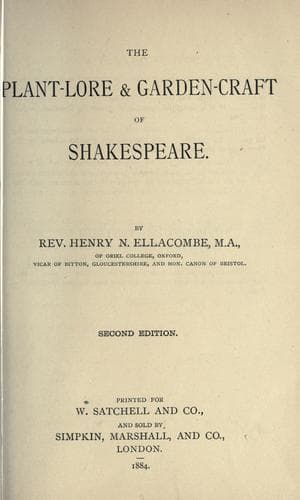
The plant-lore & garden-craft of ShakespeareEllacombe, Henry Nicholson
General
The plant-lore & garden-craft of Shakespeare
Ellacombe, Henry Nicholson
Gardens in literature; Plants in literature; Shakespeare, William, 1564-1616 -- Knowledge -- Botany
This may prove that Browne called the Violet a Lowly-down, but it
certainly does not prove that name to have been a common name for the
Violet. It was, however, the character of lowliness combined with
sweetness that gave the charm to the Violet in the eyes of the emblem
writers: it was for them the readiest symbol of the meekness of
humility. "Humilitas dat gratiam" is the motto that Camerarius places
over a clump of Violets. "A true widow is, in the church, as a little
March Violet shedding around an exquisite perfume by the fragrance of
her devotion, and always hidden under the ample leaves of her lowliness,
and by her subdued colouring showing the spirit of her mortification,
she seeks untrodden and solitary places," &c.--ST. FRANCIS DE SALES. And
the poets could nowhere find a fitter similitude for a modest maiden
than
"A Violet by a mossy stone
Half hidden from the eye."
Violets, like Primroses, must always have had their joyful associations
as coming to tell that the winter is passing away and brighter days are
near, for they are among
"The first to rise
And smile beneath spring's wakening skies,
The courier of a band
Of coming flowers."
Yet it is curious to note how, like Primroses, they have been ever
associated with death, especially with the death of the young. I suppose
these ideas must have arisen from a sort of pity for flowers that were
only allowed to see the opening year, and were cut off before the full
beauty of summer had come. This was prettily expressed by H. Vaughan,
the Silurist:
"So violets, so doth the primrose fall
At once the spring's pride and its funeral,
Such early sweets get off in their still prime,
And stay not here to wear the foil of time;
While coarser flowers, which none would miss, if past,
To scorching summers and cold winters last."
_Daphnis_, 1678.
It was from this association that they were looked on as apt emblems of
those who enjoyed the bright springtide of life and no more. This
feeling was constantly expressed, and from very ancient times. We find
it in some pretty lines by Prudentius--
"Nos tecta fovebimus ossa
Violis et fronde frequente,
Titulumque et frigida saxa
Liquido spargemus odore."
Shakespeare expresses the same feeling in the collection of "purple
Violets and Marigolds" which Marina carries to hang "as a carpet on the
grave" (No. 14), and again in Laertes' wish that Violets may spring from
the grave of Ophelia (No. 8), on which Steevens very aptly quotes from
Persius Satires--
"e tumulo fortunataque favillâ.
Nascentur Violæ."
In the same spirit Milton, gathering for the grave of Lycidas--
"Every flower that sad embroidery wears,"
gathers among others "the glowing Violet;" and the same thought is
repeated by many other writers.
Public-domain text, read in full here on John Shaqi.
Reviews
Reviews
No reviews yet
Be the first to share your thoughts on this work.
Elsewhere in the archive
Join the Discussion
Join the discussion
Sign in to leave a comment or review.
Sign InorCreate an account