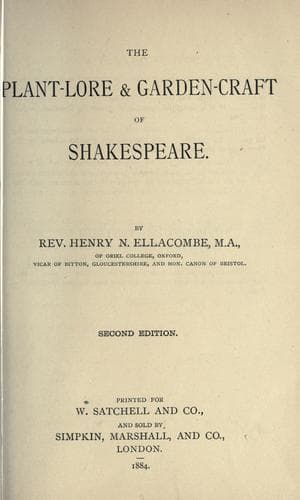
The plant-lore & garden-craft of ShakespeareEllacombe, Henry Nicholson
General
The plant-lore & garden-craft of Shakespeare
Ellacombe, Henry Nicholson
Gardens in literature; Plants in literature; Shakespeare, William, 1564-1616 -- Knowledge -- Botany
[310:1] Appel-leaf is given as the English name for Viola in two other
MS. Glossaries quoted by Cockayne, vol. iii. p. 312.
[313:1] This peculiarity is not confined to the Violet. It is found in
some species of Oxalis, Impatiens, Campanula, Eranthemum, Amphicarpea,
Leeisia, &c. Such plants are technically called Cleistogamous, and are
all self-fertilizing.
WALNUT.
(1) _Petruchio._
Why, 'tis a cockle or a Walnut-shell,
A knack, a toy, a trick, a baby's cap.
_Taming of the Shrew_, act iv, sc. 3 (66).
(2) _Ford._
Let them say of me, "As jealous as Ford that searched a hollow
Walnut for his wife's leman."
_Merry Wives of Windsor_, act iv, sc. 2 (170).
The Walnut is a native of Persia and China, and its foreign origin is
told in all its names. The Greeks called it Persicon, _i.e._, the
Persian tree, and Basilikon, _i.e._, the Royal tree; the Latins gave it
a still higher rank, naming it Juglans, _i.e._, Jove's Nut. "Hæc glans,
optima et maxima, ab Jove et glande juglans appellata est."--VARRO. The
English names tell the same story. It was first simply called Nut, as
the Nut _par excellence_. "_Juglantis vel nux_, knutu."--ÆLFRIC'S
_Vocabulary_. But in the fourteenth century it had obtained the name of
"Ban-nut," from its hardness. So it is named in a metrical Vocabulary of
the fourteenth century--
Pomus Pirus Corulus nux Avelanaque Ficus
Appul-tre Peere-tre Hasyl Note Bannenote-tre Fygge;
and this name it still holds in the West of England. But at the same
time it had also acquired the name of Walnut. "_Hec avelana_, A{ce}
Walnot-tree" (Vocabulary fourteenth century). "_Hec avelana_, a Walnutte
and the Nutte" (Nominate fifteenth century). This name is commonly
supposed to have reference to the hard shell, but it only means that
the nut is of foreign origin. "Wal" is another form of Walshe or Welch,
and so Lyte says that the tree is called "in English the Walnut and
Walshe Nut tree." "The word Welsh (_wilisc_, _woelisc_) meant simply a
foreigner, one who was not of Teutonic race, and was (by the Saxons)
applied especially to nations using the Latin language. In the Middle
Ages the French language, and in fact all those derived from Latin, and
called on that account _linguæ Romanæ_, were called in German _Welsch_.
France was called by the mediæval German writers _daz Welsche lant_, and
when they wished to express 'in the whole world,' they said, _in allen
Welschen und in Tiutschen richen_, 'in all Welsh and Teutonic kingdoms.'
In modern German the name _Wälsch_ is used more especially for
Italian."--WRIGHT'S _Celt, Roman, and Saxon_.[315:1] This will at once
explain that Walnut simply means the foreign or non-English Nut.
Public-domain text, read in full here on John Shaqi.
Reviews
Reviews
No reviews yet
Be the first to share your thoughts on this work.
Elsewhere in the archive
Join the Discussion
Join the discussion
Sign in to leave a comment or review.
Sign InorCreate an account