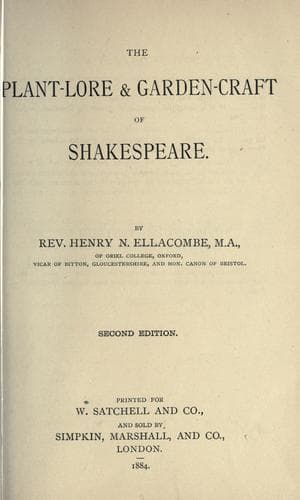
The plant-lore & garden-craft of ShakespeareEllacombe, Henry Nicholson
General
The plant-lore & garden-craft of Shakespeare
Ellacombe, Henry Nicholson
Gardens in literature; Plants in literature; Shakespeare, William, 1564-1616 -- Knowledge -- Botany
There is a remarkable botanical curiosity in the structure of the Violet
which is worth notice: it produces flowers both in spring and autumn,
but the flowers are very different. In spring they are fully formed and
sweet-scented, but they are mostly barren and produce no seed, while in
autumn they are very small, they have no petals and, I believe, no
scent, but they produce abundance of seed.[313:1]
I need say nothing to recommend the Violet in all its varieties as a
garden plant. As a useful medicinal plant it was formerly in high
repute--
"Vyolet an erbe cowth
Is knowyn in ilke manys mowthe,
As bokys seyn in here language,
It is good to don in potage,
In playstrys to wondrys it is comfortyf,
W{h} oyer erbys sanatyf:"
_Stockholm MS._
and it still holds a place in the Pharmacopœia, while the chemist
finds the pretty flowers one of the most delicate tests for detecting
the presence of acids and alkalies; but as to the many other virtues of
the Violet I cannot do better than quote Gerard's pleasant and quaint
words: "The Blacke or Purple Violets, or March Violets of the garden,
have a great prerogative above others, not only because the minde
conceiveth a certain pleasure and recreation by smelling and handling of
those most odoriferous flowres, but also for that very many by these
Violets receive ornament and comely grace; for there be made of them
garlands for the head, nosegaies, and poesies, which are delightfull to
looke on and pleasant to smell to, speaking nothing of their appropriate
vertues; yea, gardens themselves receive by these the greatest ornament
of all chiefest beautie and most gallant grace, and the recreation of
the minde which is taken thereby cannot but be very good and honest; for
they admonish and stir up a man to that which is comely and honest, for
flowres through their beautie, variety of colour, and exquisite forme,
do bring to a liberall and greatte many minde the remembrance of
honestie, comelinesse, and all kindes of vertues. For it would be an
unseemely and filthie thing (as a certain wise man saith) for him that
doth looke upon and handle faire and beautifull things, and who
frequenteth and is conversant in faire and beautifull places, to have
his minde not faire but filthie and deformed." With these brave words of
the old gardener I might well close my account of this favourite
flower, but I must add George Herbert's lines penned in the same
spirit--
"Farewell, dear flowers, sweetly your time ye spent,
Fit, while ye lived, for smell or ornament,
And after death for cures;
I follow straight without complaint or grief,
Since if my scent be good, I care not if
It be as short as yours."
_Poems on Life._
FOOTNOTES:
Public-domain text, read in full here on John Shaqi.
Reviews
Reviews
No reviews yet
Be the first to share your thoughts on this work.
Elsewhere in the archive
Join the Discussion
Join the discussion
Sign in to leave a comment or review.
Sign InorCreate an account