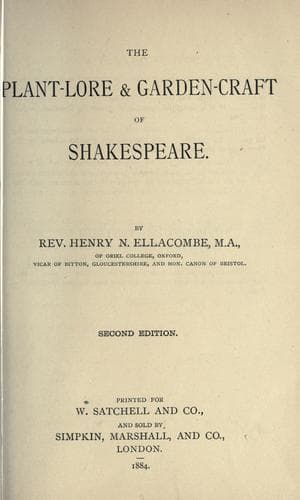
The plant-lore & garden-craft of ShakespeareEllacombe, Henry Nicholson
General
The plant-lore & garden-craft of Shakespeare
Ellacombe, Henry Nicholson
Gardens in literature; Plants in literature; Shakespeare, William, 1564-1616 -- Knowledge -- Botany
The Walnut holds an honoured place in heraldry. Two large Walnut trees
overshadow the tomb of the poet Waller in Beaconsfield churchyard, and
"these are connected with a curious piece of family history. The tree
was chosen as the Waller crest after Agincourt, where the head of the
family took the Duke of Orleans prisoner, and took afterwards as his
crest the arms of Orleans hanging by a label in a Walnut tree with this
motto for the device: _Hæc fructus virtutis._"--_Gardener's Chronicle_,
Aug., 1878.
Walnuts are still very popular, but not as poison antidotes; their
popularity now rests on their use as pickles, their excellence as autumn
and winter dessert fruits, and with pseudo-gipsies for the rich olive
hue that the juice will give to the skin. These uses, together with the
beauty in the landscape that is given by an old Walnut tree, will always
secure for it a place among English trees; yet there can be little doubt
that the Walnut is a bad neighbour to other crops, and for that reason
its numbers in England have been much diminished. Phillips said there
was a decided antipathy between Apples and Walnuts, and spoke of the
Apple tree as--
"Uneasy, seated by funereal Yew
Or Walnut (whose malignant touch impairs
All generous fruits), or near the bitter dews
Of Cherries."
And in this he was probably right, though the mischief caused to the
Apple tree more probably arises from the dense shade thrown by the
Walnut tree than by any malarious exhalation emitted from it.
FOOTNOTES:
[315:1] See Earle's "Philology of the English Tongue," p. 23.
WARDEN, _see_ PEARS.
WHEAT.
(1) _Iris._
Ceres, most bounteous lady, thy rich leas
Of Wheat, Rye, Barley, Vetches, Oats, and Pease.
_Tempest_, act iv, sc. 1 (60).
(2) _Helena._
More tuneable than lark to shepherd's ear,
When Wheat is green, when Hawthorn-buds appear.
_Midsummer Night's Dream_, act i, sc. 1 (184).
(3) _Bassanio._
His reasons are as two grains of Wheat hid in two bushels of
chaff; you shall seek all day ere you find them, and when
you have them, they are not worth the search.
_Merchant of Venice_, act i, sc. 1 (114).
(4) _Hamlet._
As peace should still her Wheaten garland wear.
_Hamlet_, act v, sc. 2 (41).
(5) _Pompey._
To send measures of Wheat to Rome.
_Antony and Cleopatra_, act ii, sc. 6 (36).
(6) _Edgar._
This is the foul fiend Flibbertigibbet. . . . He mildews the
white Wheat, and hurts the poor creatures of earth.
_King Lear_, act iii, sc. 4 (120).
(7) _Pandarus._
He that will have a cake out of the Wheat, must needs tarry
the grinding.
_Troilus and Cressida_, act i, sc. 1 (15).
(8) _Davy._
Public-domain text, read in full here on John Shaqi.
Reviews
Reviews
No reviews yet
Be the first to share your thoughts on this work.
Elsewhere in the archive
Join the Discussion
Join the discussion
Sign in to leave a comment or review.
Sign InorCreate an account