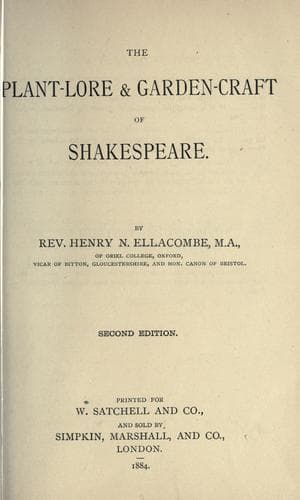
The plant-lore & garden-craft of ShakespeareEllacombe, Henry Nicholson
General
The plant-lore & garden-craft of Shakespeare
Ellacombe, Henry Nicholson
Gardens in literature; Plants in literature; Shakespeare, William, 1564-1616 -- Knowledge -- Botany
And again, sir, shall we sow the headland with Wheat?
_Shallow._
With red Wheat, Davy.
_2nd Henry IV_, act v, sc. 1 (15).
(9) _Theseus._
Your Wheaten wreathe
Was then nor threashed nor blasted.
_Two Noble Kinsmen_, act i, sc. 1 (68).
I might perhaps content myself with marking these passages only, and
dismiss Shakespeare's Wheat without further comment, for the Wheat of
his day was identical with our own; but there are a few points in
connection with English Wheat which may be interesting. Wheat is not an
English plant, nor is it a European plant; its original home is in
Northern Asia, whence it has spread into all civilized countries.[318:1]
For the cultivation of Wheat is one of the first signs of civilized
life; it marks the end of nomadic life, and implies more or less a
settled habitation. When it reached England, and to what country we are
indebted for it, we do not know; but we know that while we are indebted
to the Romans for so many of our useful trees, and fruits, and
vegetables, we are not indebted to them for the introduction of Wheat.
This we might be almost sure of from the very name, which has no
connection with the Latin names, _triticum_ or _frumentum_, but is a
pure old English word, signifying originally _white_, and so
distinguishing it as the white grain in opposition to the darker grains
of Oats and Rye. But besides the etymological evidence, we have good
historical evidence that Cæsar found Wheat growing in England when he
first landed on the shores of Kent. He daily victualled his camp with
British Wheat ("frumentum ex agris quotidie in castra conferebat"); and
it was while his soldiers were reaping the Wheat in the Kentish fields
that they were surrounded and successfully attacked by the British. He
tells us, however, that the cultivation of Wheat was chiefly confined to
Kent, and was not much known inland: "interiores plerique frumenta non
serunt, sed lacte et carne vivunt."--_De Bello Gallico_, v, 14. Roman
Wheat has frequently been found in graves, and strange stories have
been told of the plants that have been raised from these old seeds; but
a more scientific inquiry has proved that there have been mistakes or
deceits, more or less intentional, for "Wheat is said to keep for seven
years at the longest. The statements as to mummy Wheat are wholly devoid
of authenticity, as are those of the Raspberry seeds taken from a Roman
tomb."--HOOKER, "Botany" in _Science Primers_. The oft-repeated stories
about the vitality of mummy Wheat were effectually disposed of when it
was discovered that much of the so-called Wheat was South American
Maize.
FOOTNOTES:
[318:1] Yet Homer considered it to be indigenous in Sicily--Odyss: ix,
109--and Cicero, perhaps on the authority of Homer, says the same:
"Insula Cereris . . . ubi primum fruges inventæ esse dicuntur."--_In
Verrem_, v, 38.
WILLOW.
(1) _Viola._
Public-domain text, read in full here on John Shaqi.
Reviews
Reviews
No reviews yet
Be the first to share your thoughts on this work.
Elsewhere in the archive
Join the Discussion
Join the discussion
Sign in to leave a comment or review.
Sign InorCreate an account