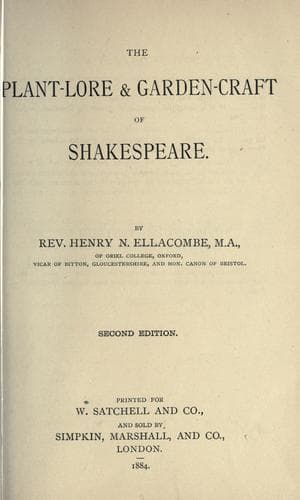
The plant-lore & garden-craft of ShakespeareEllacombe, Henry Nicholson
General
The plant-lore & garden-craft of Shakespeare
Ellacombe, Henry Nicholson
Gardens in literature; Plants in literature; Shakespeare, William, 1564-1616 -- Knowledge -- Botany
For I had then laid Wormwood to my dug.
* * * * *
When it did taste the Wormwood on the nipple
Of my dug, and felt it bitter, pretty fool.
_Romeo and Juliet_, act i, sc. 3 (26).
(3) _Hamlet_ (aside).
Wormwood, Wormwood.
_Hamlet_, act iii, sc. 2 (191).
(4)
Thy secret pleasure turns to open shame,
Thy private feasting to a public fast,
Thy smoothing titles to a ragged name,
Thy sugar'd tongue to bitter Wormwood taste.
_Lucrece_ (890).
_See also_ DIAN'S BUD.
Wormwood is the product of many species of Artemisia, a family
consisting of 180 species, of which we have four in England. The whole
family is remarkable for the extreme bitterness of all parts of the
plant, so that "as bitter as Wormwood" is one of the oldest proverbs.
The plant was named Artemisia from Artemis, the Greek name of Diana, and
for this reason: "Verily of these three Worts which we named Artemisia,
it is said that Diana should find them, and delivered their powers and
leechdom to Chiron the Centaur, who first from these Worts set forth a
leechdom, and he named these Worts from the name of Diana, Artemis, that
is, Artemisias."--_Herbarium Apulæi_, Cockayne's translation. The
Wormwood was of very high reputation in medicine, and is thus
recommended in the Stockholm MS.:
"Lif man or woman, more or lesse
In his head have gret sicknesse
Or gruiance or any werking
Awoyne he take wt. owte lettyng
It is called Sowthernwode also
And hony eteys et spurge stamp yer to
And late hy yis drunk, fastined drinky
And his hed werk away schall synkyn."[325:1]
But even in Shakespeare's time this high character had somewhat abated,
though it was still used for all medicines in which a strong bitter was
recommended. But its chief use seems to have been as a protection
against insects of all kinds, who might very reasonably be supposed to
avoid such a bitter food. This is Tusser's advice about the plant--
"While Wormwood hath seed get a handful or twaine
To save against March, to make flea to refraine:
Where chamber is sweeped and Wormwood is strowne,
No flea, for his life, dare abide to be knowne.
What saver is better (if physick be true),
For places infected than Wormwood and Rue?
It is as a comfort for hart and the braine,
And therefore to have it, it is not in vaine."
_July's Husbandry._
Public-domain text, read in full here on John Shaqi.
Reviews
Reviews
No reviews yet
Be the first to share your thoughts on this work.
Elsewhere in the archive
Join the Discussion
Join the discussion
Sign in to leave a comment or review.
Sign InorCreate an account