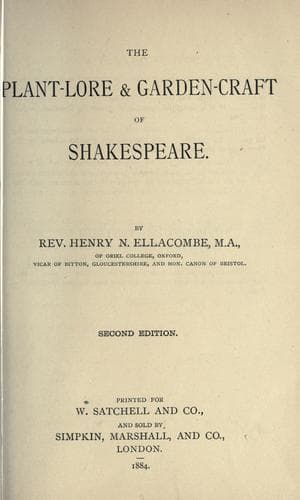
The plant-lore & garden-craft of ShakespeareEllacombe, Henry Nicholson
General
The plant-lore & garden-craft of Shakespeare
Ellacombe, Henry Nicholson
Gardens in literature; Plants in literature; Shakespeare, William, 1564-1616 -- Knowledge -- Botany
This quality was the origin of the names of Mugwort[326:1] and Wormwood.
Its other name (in the Stockholm MS. referred to), Avoyne or Averoyne is
a corruption of the specific name of one of the species, A. Abrotanum.
Southernwood is the southern Wormwood, _i.e._, the foreign, as
distinguished from the native plant. The modern name for the same
species is Boy's Love, or Old Man. The last name may have come from its
hoary leaves, though different explanations are given: the other name is
given to it, according to Dr. Prior, "from an ointment made with its
ashes being used by young men to promote the growth of a beard." There
is good authority for this derivation, but I think the name may have
been given for other reasons. "Boy's Love" is one of the most favourite
cottage-garden plants, and it enters largely into the rustic language of
flowers. No posy presented by a young man to his lass is complete
without Boy's Love; and it is an emblem of fidelity, at least it was so
once. It is, in fact, a Forget-me-Not, from its strong abiding smell; so
St. Francis de Sales applied it: "To love in the midst of sweets, little
children could do that; but to love in the bitterness of Wormwood is a
sure sign of our affectionate fidelity." Not that the Wormwood was ever
named Forget-me-Not, for that name was given to the Ground Pine (_Ajuga
chamæpitys_) on account of its unpleasant and long-enduring smell, until
it was transferred to the Myosotis (which then lost its old name of
Mouse-ear), and the pretty legend was manufactured to account for the
name.
In England Wormwood has almost fallen into complete disuse; but in
France it is largely used in the shape of Absinthe. As a garden plant,
Tarragon, which is a species of Wormwood, will claim a place in every
herb garden, and there are a few, such as A. sericea, A. cana, and A.
alpina, which make pretty shrubs for the rockwork.
FOOTNOTES:
[325:1] Wormwood had a still higher reputation among the ancients, as
the following extract shows:
Ἀρτεμισία μονόκλωνος.
Αὐει γὰρ κόπον ἀυδρὸς ὁδοιπόρου, ὅς κ᾽ ένι χέρσιν
την μονόκλωνον ἔχη· περὶ δ᾿ ἀυ ποσὶν ἕρπετα πάντα
φεύγει, ἤν τις ἔχη ἐν ὁδῶ, κὰι φάσματα δεινά.
_Anonymi Carmen de Herbis, in "Poetæ Bucolici."_
[326:1] In connection with Mugwort there is a most curious account of
the formation of a plant name given in a note in the "Promptorium
Parvulorum," s.v. Mugworte: "Mugwort, al on as seyn some, Modirwort;
lewed folk that in manye wordes conne no rygt sownyge, but ofte shortyn
wordys, and changyn lettrys and silablys, they coruptyn the _o_ in to
_a_ and _d_ in to _g_, and syncopyn _i_ smytyn a-wey _i_ and _r_ and
seyn mugwort."--_Arundel MS._, 42, f. 35 v.
YEW.
(1) _Song._
My shroud of white, stuck all with Yew,
Oh! prepare it.
_Twelfth Night_, act ii, sc. 4 (56).
_(2) 3rd Witch._
Gall of goat, and slips of Yew
Sliver'd in the moon's eclipse.
Public-domain text, read in full here on John Shaqi.
Reviews
Reviews
No reviews yet
Be the first to share your thoughts on this work.
Elsewhere in the archive
Join the Discussion
Join the discussion
Sign in to leave a comment or review.
Sign InorCreate an account