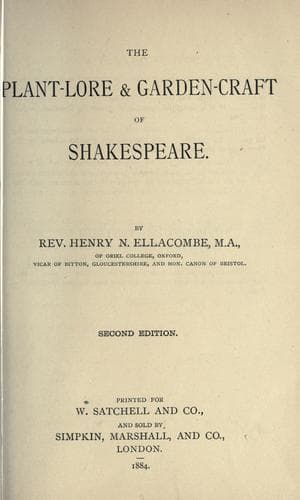
The plant-lore & garden-craft of ShakespeareEllacombe, Henry Nicholson
General
The plant-lore & garden-craft of Shakespeare
Ellacombe, Henry Nicholson
Gardens in literature; Plants in literature; Shakespeare, William, 1564-1616 -- Knowledge -- Botany
The connection of the Yew with churchyards and funerals is noticed by
Shakespeare in Nos. 1, 5, and 6, and its celebrated connection with
English bow-making in No. 3, where "double-fatal" may probably refer to
its noxious qualities when living and its use for deadly weapons
afterwards. These noxious qualities, joined to its dismal colour, and to
its constant use in churchyards, caused it to enter into the supposed
charms and incantations of the quacks of the Middle Ages. Yet Gerard
entirely denies its noxious qualities: "They say that the fruit thereof
being eaten is not onely dangerous and deadly unto man, but if birds do
eat thereof it causeth them to cast their feathers and many times to
die--all which I dare boldly affirme is altogether untrue; for when I
was yong and went to schoole, divers of my schoolfellowes, and likewise
my selfe, did eat our fils of the berries of this tree, and have not
only slept under the shadow thereof, but among the branches also,
without any hurt at all, and that not at one time but many times."
Browne says the same in his "Vulgar Errors:" "That Yew and the berries
thereof are harmlesse, we know" (book ii. c. 7). There is no doubt that
the Yew berries are almost if not quite harmless,[328:3] and I find them
forming an element in an Anglo-Saxon recipe, which may be worth quoting
as an example of the medicines to which our forefathers submitted. It is
given in a Leech Book of the tenth century or earlier, and is thus
translated by Cockayne: "If a man is in the water elf disease, then are
the nails of his hand livid, and the eyes tearful, and he will look
downwards. Give him this for a leechdom: Everthroat, cassuck, the
netherward part of fane, a yew berry, lupin, helenium, a head of marsh
mallow, fen, mint, dill, lily, attorlothe, pulegium, marrubium, dock,
elder, fel terræ, wormwood, strawberry leaves, consolida; pour them over
with ale, add holy water, sing this charm over them thrice [here follow
some long charms which I need not extract]; these charms a man may sing
over a wound" ("Leech Book," iii. 63).
Public-domain text, read in full here on John Shaqi.
Reviews
Reviews
No reviews yet
Be the first to share your thoughts on this work.
Elsewhere in the archive
Join the Discussion
Join the discussion
Sign in to leave a comment or review.
Sign InorCreate an account