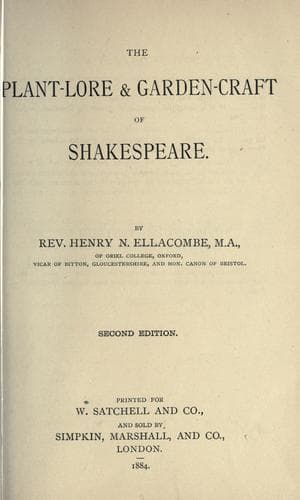
The plant-lore & garden-craft of ShakespeareEllacombe, Henry Nicholson
General
The plant-lore & garden-craft of Shakespeare
Ellacombe, Henry Nicholson
Gardens in literature; Plants in literature; Shakespeare, William, 1564-1616 -- Knowledge -- Botany
_Macbeth_, act iv, sc. 1 (27).
(3) _Scroop._
Thy very beadsmen learn to bend their bows
Of double-fatal Yew against thy state.
_Richard II_, act iii, sc. 2 (116).
(4) _Tamora._
But straight they told me they would bind me here
Unto the body of a dismal Yew.
_Titus Andronicus_, act ii, sc. 3 (106).
(5) _Paris._
Under yond Yew-trees lay thee all along,
Holding thine ear close to the hollow ground;
So shall no foot upon the churchyard tread
(Being loose, unfirm, with digging up of graves)
But thou shalt hear it.
_Romeo and Juliet_, act v, sc. 3 (3).
(6) _Balthasar._
As I did sleep under this Yew tree here,[327:1]
I dreamt my master and another fought,
And that my master slew him.
_Ibid._ (137).
_See also_ HEBENON, p. 118.
The Yew, though undoubtedly an indigenous British plant, has not a
British name. The name is derived from the Latin _Iva_, and "under this
name we find the _Yew_ so inextricably mixed up with the _Ivy_ that, as
dissimilar as are the two trees, there can be no doubt that these names
are in their origin identical." So says Dr. Prior, and he proceeds to
give a long and very interesting account of the origin of the name. The
connection of Yew with _iva_ and _Ivy_ is still shown in the French
_if_, the German _eibe_, and the Portuguese _iva_. _Yew_ seems to be
quite a modern form; in the old vocabularies the word is variously spelt
iw, ewe,[328:1] eugh-tre,[328:2] haw-tre, new-tre, ew, uhe, and iw.
Public-domain text, read in full here on John Shaqi.
Reviews
Reviews
No reviews yet
Be the first to share your thoughts on this work.
Elsewhere in the archive
Join the Discussion
Join the discussion
Sign in to leave a comment or review.
Sign InorCreate an account