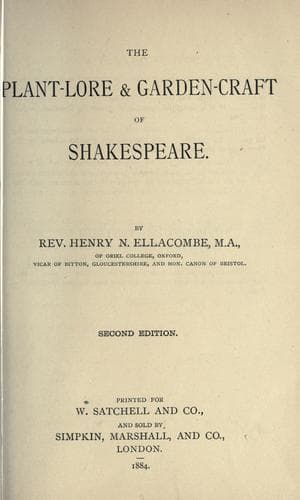
The plant-lore & garden-craft of ShakespeareEllacombe, Henry Nicholson
General
The plant-lore & garden-craft of Shakespeare
Ellacombe, Henry Nicholson
Gardens in literature; Plants in literature; Shakespeare, William, 1564-1616 -- Knowledge -- Botany
In the inquiry into Shakespeare's plants I have entered somewhat largely
into the etymological history of the names. I have been tempted into
this by the personal interest I feel in the history of plant names, and
I hope it may not have been uninteresting to my readers; but I do not
think this part of the subject could have been passed by, for I agree
with Johnston: "That there is more interest and as much utility in
settling the nomenclature of our pastoral bards as that of all
herbalists and dry-as-dust botanists" ("Botany of the Eastern Border").
I have also at times entered into the botany and physiology of the
plants; this may have seemed needless to some, but I have thought that
such notices were often necessary to the right understanding of the
plants named, and again I shelter myself under the authority of a
favourite old author: "Consider (gentle readers) what shiftes he shall
be put unto, and how rawe he must needs be in explanation of metaphors,
resemblances, and comparisons, that is ignorant of the nature of herbs
and plants from whence their similitudes be taken, for the inlightening
and garnishing of sentences."--NEWTON'S _Herball for the Bible_.
I have said that my subject naturally divides itself into two parts,
first, The Plants and Flowers named by Shakespeare; second, His
Knowledge of Gardens and Gardening. The first part is now concluded, and
I go to the second part, which will be very much shorter, and which may
be entitled "The Garden-craft of Shakespeare."
FOOTNOTES:
[327:1] The reading of the folio is "young tree," for "Yew tree."
[328:1]
"An Eu tre (Ewetre); taxus, taximus."--_Catholicon Anglicum._
[328:2]
"The eugh obedient to the bender's will."--SPENSER, _F. Q._, i. 9.
"So far as eughen bow a shaft may send."--_F. Q._, ii. 11-19.
[328:3] There are, however, well-recorded instances of death from Yew
berries. The poisonous quality, such as it is, resides in the hard seed,
and not in the red mucilaginous skin, which is the part eaten by
children. (_See_ HEBENON.)
[329:1] "For eucheson we have non Olyfe that bereth grene leves we takon
in stede of hit Hew and Palmes wyth, and beroth abowte in procession and
so this day we callyn palme sonnenday."--_Sermon for "Dominica in ramis
palmarum," Cotton MSS._
PART II.
_THE GARDEN-CRAFT OF SHAKESPEARE._
"The flowers are sweet, the colours fresh and trim."
_Venus and Adonis._
"Retired Leisure
That in trim Gardens takes his pleasure."
MILTON, _Il Penseroso_.
GARDEN-CRAFT.
Public-domain text, read in full here on John Shaqi.
Reviews
Reviews
No reviews yet
Be the first to share your thoughts on this work.
Elsewhere in the archive
Join the Discussion
Join the discussion
Sign in to leave a comment or review.
Sign InorCreate an account