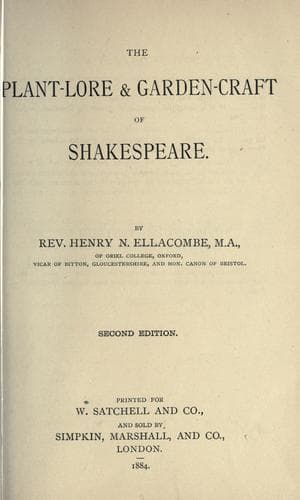
The plant-lore & garden-craft of ShakespeareEllacombe, Henry Nicholson
General
The plant-lore & garden-craft of Shakespeare
Ellacombe, Henry Nicholson
Gardens in literature; Plants in literature; Shakespeare, William, 1564-1616 -- Knowledge -- Botany
Any account of the "Plant-lore of Shakespeare" would be very incomplete
if it did not include his "Garden-craft." There are a great many
passages scattered throughout his works, some of them among the most
beautiful that he ever wrote, in which no particular tree, herb, or
flower is mentioned by name, but which show his intimate knowledge of
plants and gardening, and his great affection for them. It is from these
passages, even more than from the passages I have already quoted, in
which particular flowers are named, that we learn how thoroughly his
early country life had influenced and marked his character, and how his
whole spirit was most naturally coloured by it. Numberless allusions to
flowers and their culture prove that his boyhood and early manhood were
spent in the country, and that as he passed through the parks, fields,
and lanes of his native county, or spent pleasant days in the gardens
and orchards of the manor-houses and farm-houses of the neighbourhood,
his eyes and ears were open to all the sights and sounds of a healthy
country life, and he was, perhaps unconsciously, laying up in his memory
a goodly store of pleasant pictures and homely country talk, to be
introduced in his own wonderful way in tragedies and comedies, which,
while often professedly treating of very different times and countries,
have really given us some of the most faithful pictures of the country
life of the Englishman of Queen Elizabeth's time, drawn with all the
freshness and simplicity that can only come from a real love of the
subject.
"Flowers I noted," is his own account of himself (Sonnet xcix.), and
with what love he noted them, and with what carefulness and faithfulness
he wrote of them, is shown in every play he published, and almost in
every act and every scene. And what I said of his notices of particular
flowers is still more true of his general descriptions--that they are
never laboured, or introduced as for a purpose, but that each passage is
the simple utterance of his ingrained love of the country, the natural
outcome of a keen, observant eye, joined to a great power of faithful
description, and an unlimited command of the fittest language. It is
this vividness and freshness that gives such a reality to all
Shakespeare's notices of country life, and which make them such pleasant
reading to all lovers of plants and gardening.
Public-domain text, read in full here on John Shaqi.
Reviews
Reviews
No reviews yet
Be the first to share your thoughts on this work.
Elsewhere in the archive
Join the Discussion
Join the discussion
Sign in to leave a comment or review.
Sign InorCreate an account