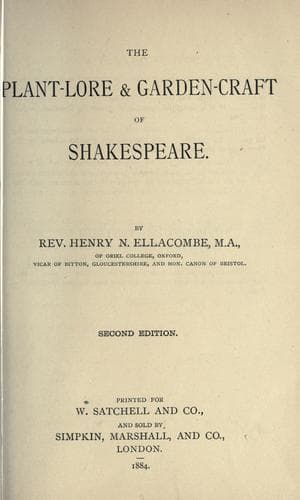
The plant-lore & garden-craft of ShakespeareEllacombe, Henry Nicholson
General
The plant-lore & garden-craft of Shakespeare
Ellacombe, Henry Nicholson
Gardens in literature; Plants in literature; Shakespeare, William, 1564-1616 -- Knowledge -- Botany
The old gardening books are full of designs for these knots; indeed, no
gardening book of the date seems to have been considered complete if it
did not give the "latest designs," and they seem to have much tried the
wit and ingenuity of the gardeners, as they must have also sorely tried
their patience to keep them in order; and I doubt not that the
efficiency of an Elizabethan gardener was as much tested by his skill
and experience in "knot-work," as the efficiency of a modern gardener is
tested by his skill in "bedding-out," which is the lineal descendant of
"knot-work." In one most essential point, however, the two systems very
much differed. In "bedding-out" the whole force of the system is spent
in producing masses of colours, the individual flowers being of no
importance, except so far as each flower contributes its little share of
colour to the general mass; and it is for this reason that so many of us
dislike the system, not only because of its monotony, but more
especially because it has a tendency "to teach us to think too little
about the plants individually, and to look at them chiefly as an
assemblage of beautiful colours. It is difficult in those blooming
masses to separate one from another; all produce so much the same sort
of impression. The consequence is people see the flowers on the beds
without caring to know anything about them or even to ask their names.
It was different in the older gardens, because there was just variety
there; the plants strongly contrasted with each other, and we were ever
passing from the beautiful to the curious. Now we get little of
quaintness or mystery, or of the strange delicious thought of being lost
or embosomed in a tall rich wood of flowers. All is clear, definite, and
classical, the work of a too narrow and exclusive taste."--FORBES
WATSON. The old "knot-work" was not open to this censure, though no
doubt it led the way which ended in "bedding-out." The beginning of the
system crept in very shortly after Shakespeare's time. Parkinson spoke
of an arrangement of spring flowers which, when "all planted in some
proportion as near one unto another as is fit for them will give such a
grace to the garden that the place will seem like a piece of tapestry of
many glorious colours, to encrease every one's delight." And again--"The
Tulipas may be so matched, one colour answering and setting off another,
that the place where they stand may resemble a piece of curious
needlework or piece of painting." But these plants were all perennial,
and remained where they were once planted, and with this one exception
named by Parkinson, the planting of knot-work was as different as
possible from the modern planting of carpet-beds. The beds were planted
inside their thick margins with a great variety of plants, and
apparently set as thick as possible, like Harrison's garden quoted
above, with its 300 separate plants in as many square feet. These were
Public-domain text, read in full here on John Shaqi.
Reviews
Reviews
No reviews yet
Be the first to share your thoughts on this work.
Elsewhere in the archive
Join the Discussion
Join the discussion
Sign in to leave a comment or review.
Sign InorCreate an account