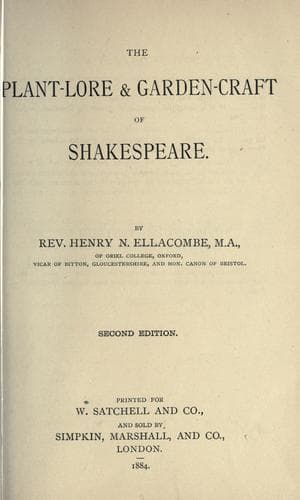
The plant-lore & garden-craft of ShakespeareEllacombe, Henry Nicholson
General
The plant-lore & garden-craft of Shakespeare
Ellacombe, Henry Nicholson
Gardens in literature; Plants in literature; Shakespeare, William, 1564-1616 -- Knowledge -- Botany
nearly all hardy perennials,[347:1] with the addition of a few hardy
annuals, and the great object seems to have been to have had something
of interest or beauty in these gardens at all times of the year. The
principle of the old gardeners was that "Nature abhors a vacuum," and,
as far as their gardens went, they did their best to prevent a vacuum
occurring at any time. In this way I think they surpassed us in their
practical gardening, for, even if they did not always succeed, it was
surely something for them to aim (in Lord Bacon's happy words), "to have
_ver perpetuum_ as the place affords."
Where the space would allow of it, the garden was further decorated with
statues, fountains, "fair mounts," labyrinths, mazes,[347:2] arbours and
alcoves, rocks, "great Turkey jars," and "in some corner (or more) a
true Dial or Clock, and some Antick works" (Lawson). These things were
fitting ornaments in such formal gardens, but the best judges saw that
they were not necessaries, and that the garden was complete without
them. "They be pretty things to look on, but nothing for health or
sweetness." "Such things are for state and magnificence, but nothing to
the true pleasure of a garden."
Such was the Elizabethan garden in its general outlines; the sort of
garden which Shakespeare must have often seen both in Warwickshire and
in London. According to our present ideas such a garden would be far too
formal and artificial, and we may consider that the present fashion of
our gardens is more according to Milton's idea of Eden, in which there
grew--
"Flowers worthy of Paradise, which not nice art
In beds and curious knots, but Nature boon
Poured forth profuse on hill and dale and plaine."
_Paradise Lost_, book iv.
None of us probably would now wish to exchange the straight walks and
level terraces of the sixteenth century for our winding walks and
undulating lawns, in the laying out of which the motto has been "ars est
celare artem"--
"That which all faire workes doth most aggrace,
The art, which all that wrought, appeareth in no place."
_F. Q._, ii, xii, 58.
Yet it is pleasant to look back upon these old gardens, and to see how
they were cherished and beloved by some of the greatest and noblest of
Englishmen. Spenser has left on record his judgment on the gardens of
his day--
"To the gay gardens his unstaid desire
Him wholly carried, to refresh his sprights;
There lavish Nature, in her best attire,
Poures forth sweete odors and alluring sights:
And Arte, with her contending, doth aspire
To excell the naturall with made delights;
And all, that faire or pleasant may be found,
In riotous excesse doth there abound.
* * * * *
Public-domain text, read in full here on John Shaqi.
Reviews
Reviews
No reviews yet
Be the first to share your thoughts on this work.
Elsewhere in the archive
Join the Discussion
Join the discussion
Sign in to leave a comment or review.
Sign InorCreate an account