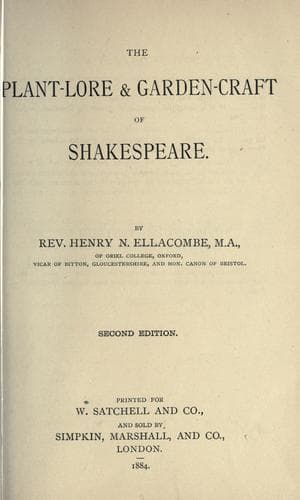
The plant-lore & garden-craft of ShakespeareEllacombe, Henry Nicholson
General
The plant-lore & garden-craft of Shakespeare
Ellacombe, Henry Nicholson
Gardens in literature; Plants in literature; Shakespeare, William, 1564-1616 -- Knowledge -- Botany
There he arriving around about doth flie,
From bed to bed, from one to other border;
And takes survey, with curious busie eye,
Of every flowre and herbe there set in order."
_Muiopotmos._
Clearly in Spenser's eyes the formalities of an Elizabethan garden (for
we must suppose he had such in his thoughts) did not exclude nature or
beauty.
It was also with such formal gardens in his mind and before his eyes
that Lord Bacon wrote his "Essay on Gardens," and commenced it with the
well-known sentence (for I must quote him once again for the last time),
"God Almighty first planted a garden, and indeed it is the purest of all
human pleasures; it is the greatest refreshment to the spirits of man,
without which buildings and palaces are but gross handiworks; and a man
shall ever see, that when ages grow to civility and elegance, men come
to build stately sooner than to garden finely, as if gardening were the
greater perfection." And, indeed, in spite of their stiffness and
unnaturalness, there must have been a great charm in those gardens, and
though it would be antiquarian affectation to attempt or wish to
restore them, yet there must have been a stateliness about them which
our gardens have not, and they must have had many points of real comfort
which it seems a pity to have lost. Those long shady "covert alleys,"
with their "thick-pleached" sides and roof, must have been very pleasant
places to walk in, giving shelter in winter, and in summer deep shade,
with the pleasant smell of Sweet Brier and Roses. They must have been
the very places for a thoughtful student, who desired quiet and
retirement for his thoughts--
"And adde to these retired leisure
That in trim gardens takes his pleasure"--
_Il Penseroso._
and they must have been also "pretty retiring places for conference" for
friends in council. The whole fashion of the Elizabethan garden has
passed away, and will probably never be revived; but before we condemn
it as a ridiculous fashion, unworthy of the science of gardening, we may
remember that it held its ground in England for nearly two hundred
years, and that during that time the gardens of England and the flowers
they bore won not the cold admiration, but the warm affection of the
greatest names in English history, the affection of such a queen as
Elizabeth,[349:1] of such a grave and wise philosopher as Bacon, of such
a grand hero as Raleigh, of such poets as Spenser and Shakespeare.
FOOTNOTES:
[343:1] These beds (as we should now call them) were called "tables" or
"plots"--
"Mark out the tables, ichon by hem selve
Sixe foote in brede, and xii in length is beste
To clense and make on evey side honest."
_Palladius on Husbandrie_, i. 116.
"Note this generally that all plots are square."--LAWSON'S _New
Orchard_, p. 60.
Public-domain text, read in full here on John Shaqi.
Reviews
Reviews
No reviews yet
Be the first to share your thoughts on this work.
Elsewhere in the archive
Join the Discussion
Join the discussion
Sign in to leave a comment or review.
Sign InorCreate an account