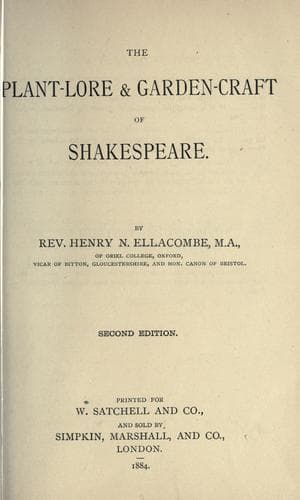
The plant-lore & garden-craft of ShakespeareEllacombe, Henry Nicholson
General
The plant-lore & garden-craft of Shakespeare
Ellacombe, Henry Nicholson
Gardens in literature; Plants in literature; Shakespeare, William, 1564-1616 -- Knowledge -- Botany
Go, bind thou up yon dangling Apricocks,
Which, like unruly children, make their sire
Stoop with oppression of their prodigal weight:
Give some supportance to the bending twigs.
Go thou, and like an executioner,
Cut off the heads of too-fast growing sprays,
That look too lofty in our commonwealth:
All must be even in our government.
You thus employ'd, I would go root away
The noisome weeds, which without profit suck
The soil's fertility from wholesome flowers.
* * * * *
O, what pity is it,
That he had not so trimm'd and dress'd his land
As we this garden! We at time of year
Do wound the bark, the skin of our fruit-trees,
Lest, being over-proud in sap and blood,
With too much riches it confound itself:
Had he done so to great and growing men,
They might have lived to bear and he to taste
Their fruits of duty; superfluous branches
We lop away, that bearing boughs may live:
Had he done so, himself had borne the crown
Which waste of idle hours hath quite thrown down.
_Richard II_, act iii, sc. 4 (29).
This most interesting passage would almost tempt us to say that
Shakespeare was a gardener by profession; certainly no other passages
that have been brought to prove his real profession are more minute than
this. It proves him to have had practical experience in the work, and I
think we may safely say that he was no mere 'prentice hand in the use of
the pruning knife.
The art of pruning in his day was probably exactly like our own, as far
as regarded fruit trees and ordinary garden work, but in one important
particular the pruner's art of that day was a for more laborious art
than it is now. The topiary art must have been the triumph of pruning,
and when gardens were full of castles, monsters, beasts, birds, fishes,
and men, all cut out of Box and Yew, and kept so exact that they boasted
of being the "living representations" and "counterfeit presentments" of
these various objects, the hands and head of the pruner could seldom
have been idle; the pruning knife and scissors must have been in
constant demand from the first day of the year to the last. The pruner
of that day was, in fact, a sculptor, who carved his images out of Box
and Yew instead of marble, so that in an amusing article in the
"Guardian" for 1713 (No. 173), said to have been written by Pope, is a
list of such sculptured objects for sale, and we are told that the
"eminent town gardener had arrived to such perfection that he cuts
family pieces of men, women, and children. Any ladies that please may
have their own effigies in Myrtle, or their husbands in Hornbeam. He is
a Puritan wag, and never fails when he shows his garden to repeat that
passage in the Psalms, 'Thy wife shall be as the fruitful Vine, and thy
children as Olive branches about thy table.'"
B. MANURING, ETC.
Public-domain text, read in full here on John Shaqi.
Reviews
Reviews
No reviews yet
Be the first to share your thoughts on this work.
Elsewhere in the archive
Join the Discussion
Join the discussion
Sign in to leave a comment or review.
Sign InorCreate an account