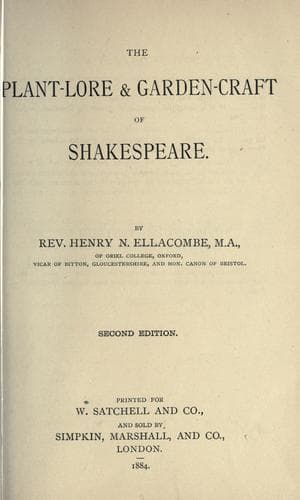
The plant-lore & garden-craft of ShakespeareEllacombe, Henry Nicholson
General
The plant-lore & garden-craft of Shakespeare
Ellacombe, Henry Nicholson
Gardens in literature; Plants in literature; Shakespeare, William, 1564-1616 -- Knowledge -- Botany
_Constable._
And you shall find his vanities forespent
Were but the outside of the Roman Brutus,
Covering discretion with a coat of folly;
As gardeners do with ordure hide those roots
That shall first spring and be most delicate.
_Henry V_, act ii, sc. 4 (36).
The only point that needs notice under this head is that the word
"manure" in Shakespeare's time was not limited to its present modern
meaning. In his day "manured land" generally meant cultured land in
opposition to wild and barren land.[353:1] So Falstaff uses the word--
Hereof comes it that Prince Harry is valiant; for the cold
blood he did naturally inherit of his father, he hath, like
lean, sterile and bare land, manured, husbanded, and tilled
with excellent endeavour of drinking good and good store of
fertile sherris, that he is become very hot and valiant.
_2nd Henry IV_, act iv, sc. 3 (126).
And in the same way Iago says--
Either to have it (a garden) sterile with idleness or manured
with industry.
_Othello_, act i, sc. 3 (296).
Milton and many other writers used the word in this its original sense;
and Johnson explains it "to cultivate by manual labour," according to
its literal derivation. In one passage Shakespeare uses the word
somewhat in the modern sense--
_Carlisle._ The blood of English shall manure the ground.
_Richard II_, act iv, sc. 1 (137).
But generally he and the writers of that and the next century expressed
the operation more simply and plainly, as "covering with ordure," or as
in the English Bible, "I shall dig about it and dung it."
C. GRAFTING.
(1) _Buckingham._
Her royal stock graft with ignoble plants.
_Richard III_, act iii, sc. 7 (127).
(2) _Dauphin._
O Dieu vivant! shall a few sprays of us,
The emptying of our fathers' luxury,
Our scions, put in wild and savage stock,
Spirt up so suddenly into the clouds,
And overlook their grafters?
_Henry V_, act iii, sc. 5 (5).
(3) _King._
His plausive words
He scatter'd not in ears, but grafted them,
To grow there and to bear.
_All's Well that Ends Well_, act i, sc. 2 (53).
(4) _Perdita._
The fairest flowers o' the season
Are our Carnations and streak'd Gillyvors,
Which some call nature's bastards: of that kind
Our rustic garden's barren; I care not
To get slips of them.
_Polixenes._
Wherefore, gentle maiden,
Do you neglect them?
_Perdita._
For I have heard it said
There is an art which in their piedness shares
With great creating Nature.
_Polixenes._
Public-domain text, read in full here on John Shaqi.
Reviews
Reviews
No reviews yet
Be the first to share your thoughts on this work.
Elsewhere in the archive
Join the Discussion
Join the discussion
Sign in to leave a comment or review.
Sign InorCreate an account