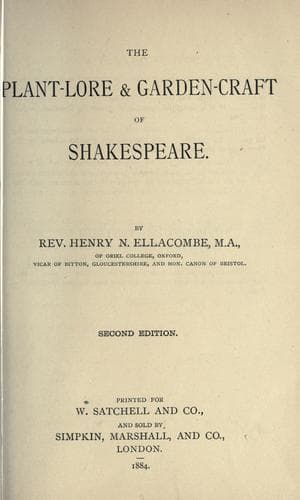
The plant-lore & garden-craft of ShakespeareEllacombe, Henry Nicholson
General
The plant-lore & garden-craft of Shakespeare
Ellacombe, Henry Nicholson
Gardens in literature; Plants in literature; Shakespeare, William, 1564-1616 -- Knowledge -- Botany
Say there be;
Yet Nature is made better by no mean,
But Nature makes that mean: so, over that art
Which you say adds to Nature, is an art
That Nature makes. You see, sweet maid, we marry
A gentle scion to the wildest stock,
And make conceive a bark of baser kind
By bud of nobler race: this is an art
Which does mend nature, change it rather, but
The art itself is nature.
_Perdita._
So it is.
_Polixenes._
Then make your garden rich in Gillyvors,
And do not call them bastards.
_Perdita._
I'll not put
The dibble in the earth to set one slip of them.
_Winter's Tale_, act iv, sc. 4 (81).
The various ways of propagating plants by grafts, cuttings, slips, and
artificial impregnation (all mentioned in the above passages), as used
in Shakespeare's day, seem to have been exactly like those of our own
time, and so they need no further comment.
FOOTNOTES:
[353:1] The Act 31 Eliz. c. 7, enacts that "noe person shall within this
Realme of England make buylde or erect any Buyldinge or Howsinge . . . .
as a Cottage for habitation . . . . unlesse the same person do assigne
and laye to the same Cottage or Buyldinge fower acres of Grounde at the
least . . . to be contynuallie occupied and manured therewith." Gerard's
Chapter on Vines is headed, "Of the manured Vine."
V.--GARDEN ENEMIES.
A. WEEDS.
(1) _Hamlet._
How weary, stale, flat, and unprofitable
Seem to me all the uses of this world!
Fye on it, ah fye! 'tis an unweeded garden
That grows to seed; things rank and gross in nature
Possess it merely.
_Hamlet_, act i, sc. 2 (133).
(2) _Titus._
Such withered herbs as these
Are meet for plucking up.
_Titus Andronicus_, act iii, sc. 1 (178).
(3) _York._
Grandam, one night, as we did sit at supper,
My Uncle Rivers talk'd how I did grow
More than my brother. "Ay," quoth my Uncle Glo'ster,
"Small herbs have grace, great weeds do grow apace;"
And since, methinks, I would not grow so fast,
Because sweet flowers are slow and weeds make haste.
_Richard III_, act ii, sc. 4 (10).
(4) _Queen._
Now 'tis the spring, and weeds are shallow-rooted;
Suffer them now, and they'll o'ergrow the garden,
And choke the herbs for want of husbandry.
_2nd Henry VI_, act iii, sc. 1 (31).
(5)
Unruly blasts wait on the tender spring,
Unwholesome weeds take root with precious flowers.
_Lucrece_ (869).
(6) _K. Henry._
Most subject is the fattest soil to weeds.
_2nd Henry IV_, act iv, sc. 4 (54).
Public-domain text, read in full here on John Shaqi.
Reviews
Reviews
No reviews yet
Be the first to share your thoughts on this work.
Elsewhere in the archive
Join the Discussion
Join the discussion
Sign in to leave a comment or review.
Sign InorCreate an account