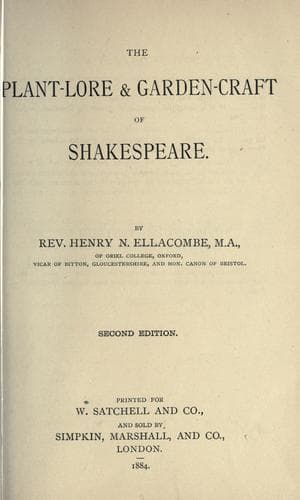
The plant-lore & garden-craft of ShakespeareEllacombe, Henry Nicholson
General
The plant-lore & garden-craft of Shakespeare
Ellacombe, Henry Nicholson
Gardens in literature; Plants in literature; Shakespeare, William, 1564-1616 -- Knowledge -- Botany
The poetry or poetical history of the Daisy is very curious. It begins
with Chaucer, whose love of the flower might almost be called an
idolatry. But, as it begins with Chaucer, so, for a time, it almost ends
with him. Spenser, Shakespeare, and Milton scarcely mention it. It holds
almost no place in the poetry of the seventeenth and eighteenth
centuries; but, at the close of the eighteenth century, it has the good
luck to be uprooted by Burns's plough, and he at once sings its dirge
and its beauties; and then the flower at once becomes a celebrity.
Wordsworth sings of it in many a beautiful verse; and I think it is
scarcely too much to say that since his time not an English poet has
failed to pay his homage to the humble beauty of the Daisy. I do not
purpose to take you through all these poets--time and knowledge would
fail me to introduce you to them all. I shall but select some of those
which I consider best worth selection. I begin, of course, with Chaucer,
and even with him I must content myself with a selection--
"Of all the floures in the mede,
Then love I most those floures white and redde;
Such that men callen Daisies in our town.
To them I have so great affection,
As I said erst when comen is the Maye,
That in my bedde there dawneth me no daie,
That I n'am up and walking in the mede
To see this floure against the sunné sprede.
When it upriseth early by the morrow,
That blessed sight softeneth all my sorrow.
So glad am I, when that I have presence
Of it, to done it all reverence--
As she that is of all floures the floure,
Fulfilled of all virtue and honoure;
And ever ylike fair and fresh of hue,
And ever I love it, and ever ylike new,
And ever shall, till that mine heart die,
All swear I not, of this I will not lye.
There loved no wight hotter in his life,
And when that it is eve, I run blithe,
As soon as ever the sun gaineth west,
To see this floure, how it will go to rest.
For fear of night, so hateth she darkness,
Her cheer is plainly spread in the brightness
Of the sunne, for there it will unclose;
Alas, that I ne had English rhyme or prose
Suffisaunt this floure to praise aright."
I could give you several other quotations from Chaucer, but I will
content myself with this, for I think unbounded admiration of a flower
can scarcely go further than the lines I have read to you.
In an early poem published by Ritson is the following--
"Lenten ys come with love to toune
With blosmen ant with briddes roune
That al thys blisse bryngeth;
Dayeseyes in this dales,
Notes suete of nyghtegales
Vch foul song singeth."
_Ancient Songs and Ballads_, vol. i, p. 63.
Stephen Hawes, who lived in the time of Henry VII., wrote a poem called
the "Temple of Glass." In that temple he tells us--
Public-domain text, read in full here on John Shaqi.
Reviews
Reviews
No reviews yet
Be the first to share your thoughts on this work.
Elsewhere in the archive
Join the Discussion
Join the discussion
Sign in to leave a comment or review.
Sign InorCreate an account