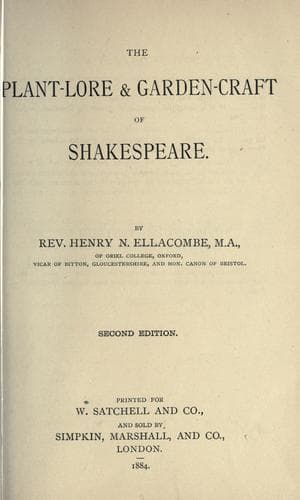
The plant-lore & garden-craft of ShakespeareEllacombe, Henry Nicholson
General
The plant-lore & garden-craft of Shakespeare
Ellacombe, Henry Nicholson
Gardens in literature; Plants in literature; Shakespeare, William, 1564-1616 -- Knowledge -- Botany
"I saw depycted upon a wall,
From est to west, fol many a fayre image
Of sundry lovers. . . . ."
And among these lovers--
"And Alder next was the freshe quene,
I mean Alceste, the noble true wife,
And for Admete howe she lost her life,
And for her trouthe, if I shall not lye,
How she was turned into a Daysye."
We next come to Spenser. In the "Muiopotmos," he gives a list of flowers
that the butterfly frequents, with most descriptive epithets to each
flower most happily chosen. Among the flowers are--
"The Roses raigning in the pride of May,
Sharp Isope good for greene woundes' remedies,
Faire Marigoldes, and bees-alluring Thyme,
Sweet Marjoram, and Daysies decking prime."
By "decking prime" he means they are the ornament of the morning.[366:1]
Again he introduces the Daisy in a stanza of much beauty, that commences
the June Eclogue of the "Shepherd's Calendar."
"Lo! Colin, here the place whose pleasaunt syte
From other shades hath weand my wandring minde.
Tell me, what wants me here to work delyte?
The simple ayre, the gentle warbling winde,
So calm, so cool, as no where else I finde;
The Grassie ground, with daintie Daysies dight;
The Bramble bush, where byrdes of every kinde
To the waters' fall their tunes attemper right."
From Spenser we come to Shakespeare, and when we remember the vast
acquaintance with flowers of every kind that he shows, and especially
when we remember how often he almost seems to go out of his way to tell
of the simple wild flowers of England, it is surprising that the Daisy
is almost passed over entirely by him. Here are the passages in which he
names the flowers. First, in the poem of the "Rape of Lucrece," he has a
very pretty picture of Lucrece as she lay asleep--
"Without the bed her other faire hand was
On the green coverlet, whose perfect white
Showed like an April Daisy on the Grass."
In "Love's Labour's Lost" is the song of Spring, beginning--
"When Daisies pied, and Violets blue;
And Lady-smocks all silver-white,
And Cuckoo-buds of yellow hue
Do paint the meadows with delight."
In "Hamlet" Daisies are twice mentioned in connection with Ophelia in
her madness. "There's a Daisy!" she said, as she distributed her
flowers; but she made no comment on the Daisy as she did on her other
flowers. And, in the description of her death, the Queen tells us that--
"There with fantastick garlands did she come
Of Crow-flowers, Nettles, Daisies, and Long Purples."
And in "Cymbeline" the General Lucius gives directions for the burial of
Cloten--
"Let us
Find out the prettiest Daisied plot we can,
And make him with our pikes and partisans
A grave."
Public-domain text, read in full here on John Shaqi.
Reviews
Reviews
No reviews yet
Be the first to share your thoughts on this work.
Elsewhere in the archive
Join the Discussion
Join the discussion
Sign in to leave a comment or review.
Sign InorCreate an account