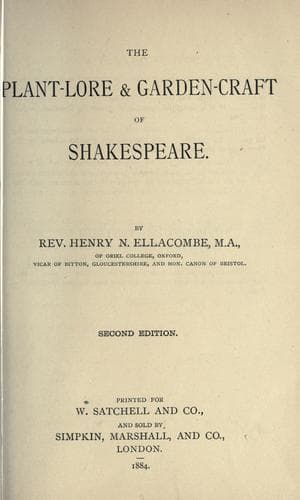
The plant-lore & garden-craft of ShakespeareEllacombe, Henry Nicholson
General
The plant-lore & garden-craft of Shakespeare
Ellacombe, Henry Nicholson
Gardens in literature; Plants in literature; Shakespeare, William, 1564-1616 -- Knowledge -- Botany
"When soothed awhile by milder airs,
Thee Winter in the garland wears,
That thinly shades his few gray hairs,
Spring cannot shun thee.
While Summer fields are thine by right,
And Autumn, melancholy wight,
Doth in thy crimson head delight
When rains are on thee.
Child of the year that round dost run
Thy course, bold lover of the sun,
And cheerful when thy day's begun
As morning leveret.
Thy long-lost praise thou shalt regain,
Dear shalt thou be to future men,
As in old time, thou not in vain
Art nature's favourite."
The other poem from Wordsworth that I shall read to you is one that has
received the highest praise from all readers, and by Ruskin (no mean
critic, and certainly not always given to praises) is described as "two
delicious stanzas, followed by one of heavenly imagination."[372:1] The
poem is "An Address to the Daisy"--
"A nun demure--of holy port;
A sprightly maiden--of love's court,
In thy simplicity the sport
Of all temptations.
A queen in crown of rubies drest,
A starveling in a scanty vest,
Are all, as seems to suit thee best,
Thy appellations.
I see thee glittering from afar,
And then thou art a pretty star,
Not quite so fair as many are
In heaven above thee.
Yet like a star with glittering crest,
Self-poised in air thou seem'st to rest;
Let peace come never to his rest
Who shall reprove thee.
Sweet flower, for by that name at last,
When all my reveries are past,
I call thee, and to that cleave fast.
Sweet silent creature,
That breath'st with me in sun and air;
Do thou, as thou art wont, repair
My heart with gladness, and a share
Of thy meek nature."
With these beautiful lines I might well conclude my notices of the
poetical history of the Daisy, but, to bring it down more closely to our
own times, I will remind you of a poem by Tennyson, entitled "The
Daisy." It is a pleasant description of a southern tour brought to his
memory by finding a dried Daisy in a book. He says--
"We took our last adieu,
And up the snowy Splugen drew,
But ere we reached the highest summit,
I plucked a Daisy, I gave it you,
It told of England then to me,
And now it tells of Italy."
Thus I have picked several pretty flowers of poetry for you from the
time of Chaucer to our own. I could have made the posy fifty-fold
larger, but I could, probably, have found no flowers for the posy more
beautiful, or more curious, than these few.
Public-domain text, read in full here on John Shaqi.
Reviews
Reviews
No reviews yet
Be the first to share your thoughts on this work.
Elsewhere in the archive
Join the Discussion
Join the discussion
Sign in to leave a comment or review.
Sign InorCreate an account