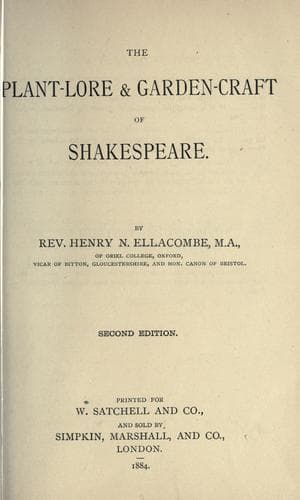
The plant-lore & garden-craft of ShakespeareEllacombe, Henry Nicholson
General
The plant-lore & garden-craft of Shakespeare
Ellacombe, Henry Nicholson
Gardens in literature; Plants in literature; Shakespeare, William, 1564-1616 -- Knowledge -- Botany
I need not dwell on the other poets of the seventeenth century. In most
of them a casual allusion to the Daisy may be found, but little more.
Nor need I dwell at all on the poets of the eighteenth century. In the
so-called Augustan age of poetry, the Daisy could not hope to attract
any attention. It was the correct thing if they had to speak of the
country to speak of the "Daisied" or "Daisy-spangled" meads, but they
could not condescend to any nearer approach to the little flower. If
they had they would have found that they had chosen their epithet very
badly. I never yet saw a "Daisy-spangled" meadow.[370:1] The flowers may
be there, but the long Grasses effectually hide them. And so I come _per
saltum_ to the end of the eighteenth century, and at once to Burns, who
brought the Daisy again into notice. He thus regrets the uprooting of
the Daisy by his plough--
"Wee, modest, crimson-tippèd flower,
Thou'st met me in an evil hour;
For I must crush amongst the stour
Thy slender stem.
To spare thee now is past my power,
Thou bonny gem.
Cold blew the bitter, biting north,
Upon thy humble birth,
Yet cheerfully thou venturest forth
Amid the storm,
Scarce reared above the Parent-earth
Thy tender form.
The flaunting flowers our gardens yield
High sheltering woods and walks must shield;
But thou, between the random bield
Of clod or stone,
Adorn'st the rugged stubble field,
Unseen, alone.
There, in thy scanty mantle clad,
Thy snowy bosom sunward spread,
Thou lift'st thy unassuming head
In humble guise;
But now the share uptears thy bed,
And low thou lies!"
With Burns we may well join Clare, another peasant poet from
Northamptonshire, whose poems are not so much known as they deserve to
be. His allusions to wild flowers always mark his real observation of
them, and his allusions to the Daisy are frequent; thus--
"Smiling on the sunny plain
The lovely Daisies blow,
Unconscious of the careless feet
That lay their beauties low."
Again, alluding to his own obscurity--
"Green turfs allowed forgotten heap,
Is all that I shall have,
Save that the little Daisies creep
To deck my humble grave."
Again, in his description of evening, he does not omit to notice the
closing of the Daisy at sunset--
"Now the blue fog creeps along,
And the birds forget their song;
Flowers now sleep within their hoods,
Daisies button into buds."
And so we come to Wordsworth, whose love of the Daisy almost equalled
Chaucer's. His allusions and addresses to the Daisy are numerous, but I
have only space for a small selection. First, are two stanzas from a
long poem specially to the Daisy--
Public-domain text, read in full here on John Shaqi.
Reviews
Reviews
No reviews yet
Be the first to share your thoughts on this work.
Elsewhere in the archive
Join the Discussion
Join the discussion
Sign in to leave a comment or review.
Sign InorCreate an account