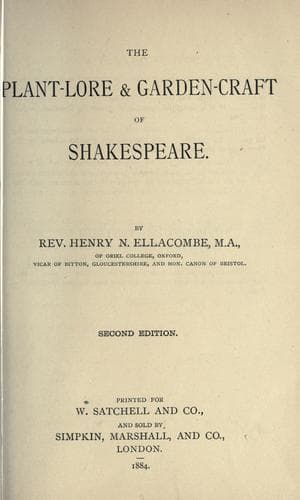
The plant-lore & garden-craft of ShakespeareEllacombe, Henry Nicholson
General
The plant-lore & garden-craft of Shakespeare
Ellacombe, Henry Nicholson
Gardens in literature; Plants in literature; Shakespeare, William, 1564-1616 -- Knowledge -- Botany
I have now gone through something of the history, poetry, and botany of
the Daisy, but there are still some few points which I could not well
range under either of these three heads, yet which must not be passed
over. In painting, the Daisy was a favourite with the early Italian and
Flemish painters, its bright star coming in very effectively in their
foregrounds. Some of you will recollect that it is largely used in the
foreground of Van Eyck's grand picture of the "Adoration of the Lamb,"
now at St. Bavon's, in Ghent. In sculpture it was not so much used, its
small size making it unfit for that purpose. Yet you will sometimes see
it, both in the stone and wood carvings of our old churches. In heraldry
it is not unknown. When Philip the Bold, Duke of Burgundy, was about to
marry Margaret of Flanders, he instituted an order of Daisies; and in
Chifflet's Lilium Francicum (1658) is a plate of his arms, France and
Flanders quarterly surrounded by a collar of Daisies. A family named
Daisy bear three Daisies on their coat of arms. In an old picture of
Chaucer, a Daisy takes the place in the corner usually allotted to the
coat of arms in mediæval paintings. It was assumed as an heraldic
cognizance by St. Louis of France in honour of his wife Margaret; by the
good Margaret of Valois, Queen of Navarre; by Margaret of Anjou, the
unfortunate wife of our Henry VI.; while our Margaret, Countess of
Richmond, mother of our Henry VII., and dear to Oxford and Cambridge as
the foundress of the Margaret Professorships, and of Christ College in
Cambridge, bore three Daisies on a green turf.
To entomologists the Daisy is interesting as an attractive flower to
insects; for "it is visited by nine hymenoptera, thirteen diptera, three
coleoptera, and two lepidoptera--namely, the least meadow-brown and the
common blue butterflies."[377:1]
Public-domain text, read in full here on John Shaqi.
Reviews
Reviews
No reviews yet
Be the first to share your thoughts on this work.
Elsewhere in the archive
Join the Discussion
Join the discussion
Sign in to leave a comment or review.
Sign InorCreate an account