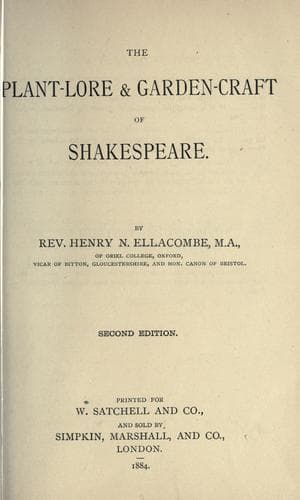
The plant-lore & garden-craft of ShakespeareEllacombe, Henry Nicholson
General
The plant-lore & garden-craft of Shakespeare
Ellacombe, Henry Nicholson
Gardens in literature; Plants in literature; Shakespeare, William, 1564-1616 -- Knowledge -- Botany
In medicine, I am afraid, the Daisy has so lost its virtues that it has
no place in the modern pharmacopœia: but in old days it was not so.
Coghan says "of Deysies, they are used to be given in potions in
fractures of the head and deep wounds of the breast. And this experience
I have of them, that the juyce of the leaves and rootes of Deysies being
put into the nosethrils purgeth the brain; they are good to be used in
pottage."[377:2] Gerard says, "the Daisies do mitigate all kinds of
paines, especially in the joints, and gout proceeding from a hot or dry
humoure, if they be stamped with new butter, unsalted, and applied upon
the pained place." Nor was this all. In those days, doctors prescribed
according to the so-called "doctrines of signatures," _i.e._, it was
supposed that Nature had shown, by special marks, for what special
disease each plant was useful; and so in the humble growth of the little
low-growing Daisy the doctors read its uses, and here they are. "It is
said that the roots thereof being boyled in milk, and given to little
puppies, will not suffer them to grow great."--COLE'S _Adam in Eden_.
One more virtue. Miss Pratt says that "an author, writing in 1696, tells
us that they who wish to have pleasant dreams of the loved and absent,
should put 'Dazy roots under their pillow.'"
On the English language, the Daisy has had little influence, though some
have derived "lackadaisy" and "lackadaisical" from the Daisy, but there
is, certainly, no connection between the words. Daisy, however, was
(and, perhaps, still is) a provincial adjective in the eastern counties.
A writer in "Notes and Queries" (2nd Series, ix. 261) says that Samuel
Parkis, in a letter to George Chalmers, dated February 16, 1799, notices
the following provincialisms: "Daisy: remarkable, extraordinary
excellent, as 'She's a Daisy lass to work,' _i.e._, 'She is a good
working girl.' 'I'm a Daisy body for pudding,' _i.e._, 'I eat a great
deal of pudding.'"
And I must not leave the Daisy without noticing one special charm, that
it is peculiarly the flower of childhood. The Daisy is one of the few
flowers of which the child may pick any quantity without fear of
scolding from the surliest gardener. It is to the child the herald of
spring, when it can set its little foot on six at once, and it readily
lends itself to the delightful manufacture of Daisy chains.
"In the spring and play-time of the year,
. . . . the little ones, a sportive team,
Gather king-cups in the yellow mead,
And prank their hair with Daisies."--COWPER.
It is then the special flower of childhood, but we cannot entirely give
it up to our children. And I have tried to show you that the humble
Daisy has been the delight of many noble minds, and may be a fit subject
of study even for those children of a larger growth who form the "Bath
Field Club."
FOOTNOTES:
Public-domain text, read in full here on John Shaqi.
Reviews
Reviews
No reviews yet
Be the first to share your thoughts on this work.
Elsewhere in the archive
Join the Discussion
Join the discussion
Sign in to leave a comment or review.
Sign InorCreate an account