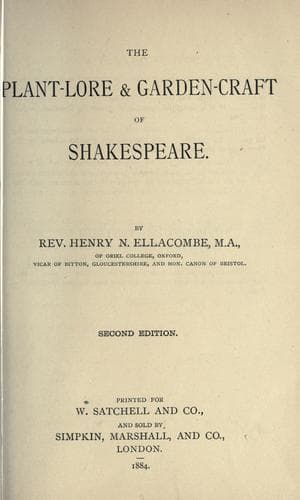
The plant-lore & garden-craft of ShakespeareEllacombe, Henry Nicholson
General
The plant-lore & garden-craft of Shakespeare
Ellacombe, Henry Nicholson
Gardens in literature; Plants in literature; Shakespeare, William, 1564-1616 -- Knowledge -- Botany
[362:1] "In the curious Treatise of the Virtues of Herbs, Royal MS. 18,
a. vi, fol. 72 b, is mentioned: 'Brysewort, or Bonwort, or Daysye,
_consolida minor_, good to breke bocches.'"--_Promptorium Parvulorum_,
p. 52, note. See also a good note on the same word in "Babee's Book," p.
185.
[366:1] This is the general interpretation, but "decking prime" may mean
the ornament of spring.
[370:1] This statement has been objected to, but I retain it, because in
speaking of a meadow, I mean what is called a meadow in the south of
England, a lowland, and often irrigated, pasture. In such a meadow
Daisies have no place. In the North the word is more loosely used for
any pasture, but in the South the distinction is so closely drawn that
hay dealers make a great difference in their prices for "upland" or
"meadow hay."
[372:1] "Modern Painters," vol. ii. p. 186.
[374:1] In the "Cornhill Magazine" for January, 1878, is a pleasant
paper on "Dissecting a Daisy," treating a little of the Daisy, but still
more of the pleasures that a Daisy gives to different people, and the
different reasons for the different sorts of pleasure. See also on the
same subject the "Cornhill" for June, 1882.
[377:1] Boulger in "Nature," Aug., 1878. The insects are given in Herman
Muller's "Befructting der Blumen."
[377:2] "Haven of Health," 1596, p. 83.
APPENDIX II.
_THE SEASONS OF SHAKESPEARE'S PLAYS._
_Biron._ I like of each thing that in season grows.
_Love's Labour's Lost_, act i, sc. 1.
This paper was read to the New Shakespeare Society in June, 1880, and
to the Bath Literary Club in the following November. The subject is so
closely connected with the "Plant-lore of Shakespeare," that I add it as
an Appendix.
THE SEASONS OF SHAKESPEARE'S PLAYS.
In this paper I do not propose to make any exhaustive inquiry into the
seasons of Shakespeare's plays, but (at Mr. Furnivall's suggestion) I
have tried to find out whether in any case the season that was in the
poet's mind can be discovered by the flowers or fruits, or whether,
where the season is otherwise indicated, the flowers and fruits are in
accordance. In other words, my inquiry is simply confined to the
argument, if any, that may be derived from the flowers and fruits,
leaving out of the question all other indications of the seasons.
The first part of the inquiry is, what plants or flowers are mentioned
in each play? They are as follows:--
COMEDIES.
_Tempest._ Apple, crab, wheat, rye, barley, vetches, oats, peas, briar,
furze, gorse, thorns, broom, cedar, corn, cowslip, nettle, docks,
mallow, filbert, heath, ling, grass, nut, ivy, lily, piony, lime,
mushrooms, oak, acorn, pignuts, pine, reed, saffron, sedges, stover,
vine.
_Two Gentlemen of Verona._ Lily, roses, sedges.
_Merry Wives._ Pippins, buttons (?), balm, bilberry, cabbage, carrot,
elder, eringoes, figs, flax, hawthorn, oak, pear, plums, prunes,
potatoes, pumpion, roses, turnips, walnut.
Public-domain text, read in full here on John Shaqi.
Reviews
Reviews
No reviews yet
Be the first to share your thoughts on this work.
Elsewhere in the archive
Join the Discussion
Join the discussion
Sign in to leave a comment or review.
Sign InorCreate an account