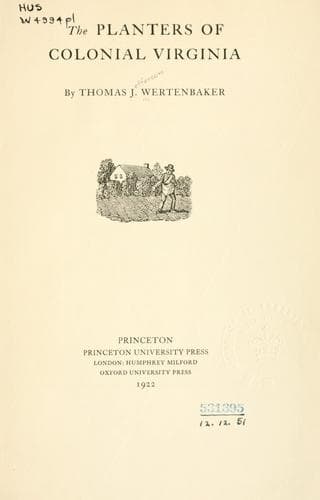
The Planters of Colonial VirginiaWertenbaker, Thomas Jefferson
History
The Planters of Colonial Virginia
Wertenbaker, Thomas Jefferson
Slavery -- Virginia; Virginia -- Economic conditions; Virginia -- History -- Colonial period, ca. 1600-1775
Produced by Mark C. Orton, Christine Aldridge and the
Online Distributed Proofreading Team at http://www.pgdp.net
Transcriber's Notes:
1. Passages in italics are surrounded by _underscores_.
2. Superscripted characters are marked by a ^carat.
3. Corrections to minor spelling, punctuation, or other errors in the
original text appear in a detailed list at the end of this e-text.
4. Notations of inconsistencies in the original text, specifically the
Appendix, Footnotes and Index, which have been retained, appear at the
end of this e-text.
5. In the chapter "NOTES ON CHAPTERS", Footnotes without anchor points
have been marked with a question mark, (ex: ?[5-3]).
_The Planters of Colonial Virginia_
_The_ PLANTERS OF COLONIAL VIRGINIA
By THOMAS J. WERTENBAKER
[Illustration]
_New York_
RUSSELL & RUSSELL
1959
COPYRIGHT 1922 BY PRINCETON UNIVERSITY PRESS
COPYRIGHT 1958, 1959 BY THOMAS J. WERTENBAKER
LIBRARY OF CONGRESS CATALOG CARD NUMBER 59-11228
PRINTED IN THE UNITED STATES OF AMERICA
PREFACE
America since the days of Captain John Smith has been the land of hope
for multitudes in Europe. In many an humble home, perhaps in some
English village, or an Ulster farm, or in the Rhine valley, one might
find a family assembled for the reading of a letter from son, or
brother, or friend, who had made the great venture of going to the New
World. "Land is abundant here and cheap," the letter would state. "Wages
are high, food is plentiful, farmers live better than lords. If one will
work only five days a week one can live grandly."
In pamphlets intended to encourage immigration the opportunities for
advancement were set forth in glowing colors. In Virginia alone, it was
stated, in 1649, there were "of kine, oxen, bulls, calves, twenty
thousand, large and good." When the traveller Welby came to America he
was surprised to "see no misery, no disgusting army of paupers, not even
beggars;" while Henry B. Fearson noted that laborers were "more erect in
their posture, less careworn in their countenances" than those of
Europe.
In Virginia, as in other colonies, it was the cheapness of land and the
dearness of labor which gave the newcomer his chance to rise. The rich
man might possess many thousands of acres, but they would profit him
nothing unless he could find the labor to put them under cultivation.
Indentured workers met his needs in part, but they were expensive, hard
to acquire, and served for only four years. If he hired freemen he
would have to pay wages which in England would have seemed fantastic.
Public-domain text, read in full here on John Shaqi.
Reviews
Reviews
No reviews yet
Be the first to share your thoughts on this work.
Join the Discussion
Join the discussion
Sign in to leave a comment or review.
Sign InorCreate an account