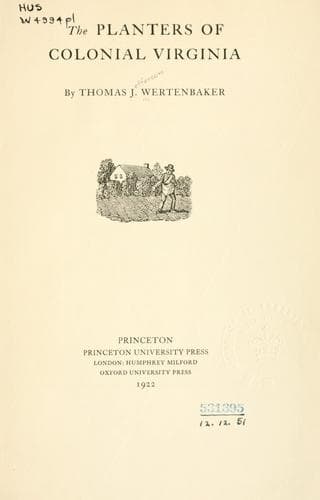
The Planters of Colonial VirginiaWertenbaker, Thomas Jefferson
History
The Planters of Colonial Virginia
Wertenbaker, Thomas Jefferson
Slavery -- Virginia; Virginia -- Economic conditions; Virginia -- History -- Colonial period, ca. 1600-1775
Of the three requirements of production--natural resources, capital and
labor--the fertile soil furnished the first in abundance, the second
could readily be secured, but the last remained for a full century the
one great problem of the planters. From the days of Sir George Yeardley
to those of Nicholson and Andros there was a persistent and eager demand
for workers. Of this there can be no better evidence than the remarkably
high wages which prevailed in the colony, especially in the years prior
to the Restoration. In fact, it is probable that the laborer received
for his services four or five times the amount he could earn in
England. Even during the time of the London Company we find George
Sandys writing to a friend in London to procure indentured servants for
the colony as the wages demanded were intolerable. A day's work brought,
in addition to food, a pound of tobacco valued at one shilling, while in
England the unskilled worker considered himself fortunate if he could
earn so much in a week.[2-16]
In his efforts to solve this acute problem the planter found little hope
in the aborigines. The Spaniards, it is true, had made use of the
Indians to till their fields or work in the gold and silver mines, but
the Pamunkey and the Powhatan were cast in a different mold from the
Aztec and the Peruvian. To hunt them out of their native lairs and bind
them to arduous and ignominious servitude was hardly to be thought of.
Their spirit was too proud to be thus broken, the safe refuge of the
woods too near at hand. One might as well have attempted to hitch lions
and tigers to the plough shaft, as to place these wild children of the
forest at the handles. At times it proved practicable to make use of
Indian children for servants, and there are numerous instances on record
in which they are found in the homes of the planters.[2-17] But this, of
course, could be of little service in solving the pressing labor
problem, in clearing new ground or tilling the idle fields. The Virginia
landowner was forced to turn elsewhere for his helpers.
Public-domain text, read in full here on John Shaqi.
Reviews
Reviews
No reviews yet
Be the first to share your thoughts on this work.
Join the Discussion
Join the discussion
Sign in to leave a comment or review.
Sign InorCreate an account