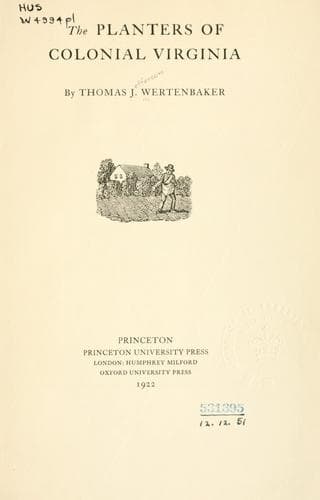
The Planters of Colonial VirginiaWertenbaker, Thomas Jefferson
History
The Planters of Colonial Virginia
Wertenbaker, Thomas Jefferson
Slavery -- Virginia; Virginia -- Economic conditions; Virginia -- History -- Colonial period, ca. 1600-1775
Throughout the entire Seventeenth century, however, the Governors had
experienced great difficulty in collecting this tax. Over and over again
they reported in their letters to the Board of Trade that there were
large arrears of quit-rents which it was impossible to make the
landowners pay.[3-35] The reason for this was obvious enough. In each
county the tax collector was the sheriff. Although this officer was
appointed by the Governor, he usually had a wholesome respect for the
larger proprietors and in consequence was wary of giving offense by
holding them to too strict an account of their estates.[3-36] At times
the sheriffs themselves were the sufferers by this state of affairs, for
they were held responsible for the rents upon all land patented in their
counties, for which returns had not been made.
Although the Governors from time to time made rather feeble attempts to
remedy the prevailing laxness in this matter, nothing of importance was
accomplished before the first administration of Francis Nicholson. The
chief executive himself had much need of the good will of the richer
inhabitants, and he was not over forward in forcing them to bring in
accurate returns. Nicholson, however, who prided himself on his
executive ability and who was bent on breaking the power of the clique
which centered around the Council of State, exerted himself to the
utmost to secure full payment for every acre.
So early as 1690 we find him issuing orders to the sheriffs for the
drawing up of an accurate rent roll, through an examination of the
patent lists and the records of land transfers.[3-37] May 15, 1691, he
took up the matter again, warning the sheriffs that he expected more
accurate returns than they had yet made.[3-38] With the appointment of
Sir Edmund Andros as Governor, however, interest in the quit-rents
lapsed, and not until his removal and the reappointment of Nicholson was
the attempt resumed.
In July, 1699, Nicholson wrote the Commissioners of Trade and
Plantations that he was doing his best to improve the quit-rents and
that the auditor had been ordered to draw up a scheme for securing a
more exact list of land holdings.[3-39] But for a while the matter still
hung fire. The leading men in the Government were ready enough in making
suggestions, but they were extensive landholders themselves and
apparently rendered no real assistance. "I have considered those papers
given me by your Excellency relating to a perfect rent roll," the
auditor, William Byrd I wrote Nicholson, Oct. 21, 1703, "notwithstanding
I have, according to your repeated directions used my utmost diligence
in giving charge to sheriffs and taking their oaths to rolls, I am
sensible there is still very great abuse therein."[3-40]
Public-domain text, read in full here on John Shaqi.
Reviews
Reviews
No reviews yet
Be the first to share your thoughts on this work.
Join the Discussion
Join the discussion
Sign in to leave a comment or review.
Sign InorCreate an account