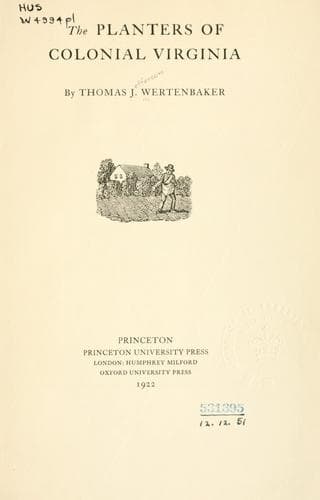
The Planters of Colonial VirginiaWertenbaker, Thomas Jefferson
History
The Planters of Colonial Virginia
Wertenbaker, Thomas Jefferson
Slavery -- Virginia; Virginia -- Economic conditions; Virginia -- History -- Colonial period, ca. 1600-1775
In addition to, but closely associated with, the economic causes of
Anglo-Saxon expansion was the realization in England of the need for
prompt action in putting a limit to the growing domains of the King of
Spain. In the century which had elapsed since Columbus opened a new
world to the peoples of Europe, this monarch had seized the richest part
of the great prize, and was still reaching forward to the north and to
the south. Unless England took advantage of the present opportunity, the
vast American continents might be closed to her forever. Anglo-Saxon
civilization in that case might well remain permanently cooped up in the
little island that had seen its inception, while the Spanish language
and Spanish institutions expanded to embrace the garden spots of the
world.[1-10]
There were still other motives for this great movement. The English felt
the prime necessity of discovering and controlling a new route to the
East, they wished to expand the influence of the Anglican church and
convert the Indians, they hoped to seize and fortify strategic points in
America which would aid them in their struggles with the Spaniards. But
these things, important as they were, paled beside the pressing
necessity of national expansion, of rehabilitating English industrial
life, restoring the merchant marine and securing economic independence.
Thus, when Captain Newport returned in 1607 to report that the colony of
Virginia had been safely launched, many Englishmen were aroused to a
high pitch of hope and expectation. Now at last a province had been
secured which could supply the raw materials which England so greatly
needed. The active supporters of the undertaking were lavish in their
promises. Virginia would yield better and cheaper timber for shipping
than Prussia or Poland, she would furnish potash in abundance, and since
wood could there be had for the cutting, her copper and iron ore could
be smelted on the spot. Wine could be made there, as excellent as that
of the Canaries, they boasted, while it was hoped soon to manufacture
silk rivalling in fineness that of Persia or of Turkey. The waters of
the colony were full of "Sturgion, Caviare and new land fish of the
best," her fields could produce hemp for cordage and flax for linen. As
for pitch, tar, turpentine and boards, there was a certainty of a rich
return.[1-11] In February 1608, the Council of Virginia wrote to the
corporation of Plymouth: "The staple and certain Comodities we have are
Soap-ashes, pitch, tar, dyes of sundry sorts and rich values, timber for
all uses, fishing for sturgeon and divers other sorts ... making of
Glass and Iron, and no improbable hope of richer mines."[1-12]
Public-domain text, read in full here on John Shaqi.
Reviews
Reviews
No reviews yet
Be the first to share your thoughts on this work.
Join the Discussion
Join the discussion
Sign in to leave a comment or review.
Sign InorCreate an account