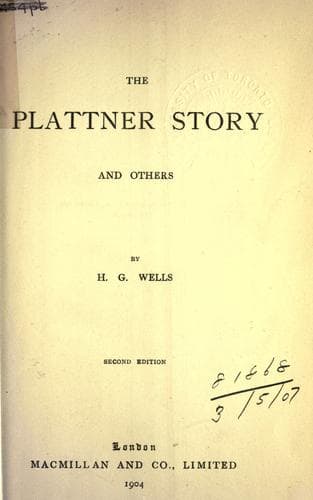
The Plattner Story, and OthersWells, H. G. (Herbert George)
Science
The Plattner Story, and Others
Wells, H. G. (Herbert George)
Great Britain -- Social life and customs -- Fiction; Science fiction; Short stories, English
And now to tell what is perhaps the most astonishing fact in this whole
astonishing raid. We have not the slightest knowledge of the subsequent
movements of the shoal, although the whole south-west coast was now
alert for it. But it may, perhaps, be significant that a cachalot
was stranded off Sark on June 3. Two weeks and three days after this
Sidmouth affair, a living _Haploteuthis_ came ashore on Calais sands.
It was alive, because several witnesses saw its tentacles moving in a
convulsive way. But it is probable that it was dying. A gentleman named
Pouchet obtained a rifle and shot it.
That was the last appearance of a living _Haploteuthis_. No others
were seen on the French coast. On the 15th of June a dead body, almost
complete, was washed ashore near Torquay, and a few days later a boat
from the Marine Biological station, engaged in dredging off Plymouth,
picked up a rotting specimen, slashed deeply with a cutlass wound. How
the former specimen had come by its death it is impossible to say. And
on the last day of June, Mr. Egbert Caine, an artist, bathing near
Newlyn, threw up his arms, shrieked, and was drawn under. A friend
bathing with him made no attempt to save him, but swam at once for
the shore. This is the last fact to tell of this extraordinary raid
from the deeper sea. Whether it is really the last of these horrible
creatures it is, as yet, premature to say. But it is believed, and
certainly it is to be hoped, that they have returned now, and returned
for good, to the sunless depths of the middle seas, out of which they
have so strangely and so mysteriously arisen.
POLLOCK AND THE PORROH MAN
It was in a swampy village on the lagoon river behind the Turner
Peninsula that Pollock's first encounter with the Porroh man occurred.
The women of that country are famous for their good looks--they are
Gallinas with a dash of European blood that dates from the days of
Vasco de Gama and the English slave-traders, and the Porroh man, too,
was possibly inspired by a faint Caucasian taint in his composition.
(It's a curious thing to think that some of us may have distant cousins
eating men on Sherboro Island or raiding with the Sofas.) At anyrate,
the Porroh man stabbed the woman to the heart as though he had been a
mere low-class Italian, and very narrowly missed Pollock. But Pollock,
using his revolver to parry the lightning stab which was aimed at his
deltoid muscle, sent the iron dagger flying, and, firing, hit the man
in the hand.
He fired again and missed, knocking a sudden window out of the wall
of the hut. The Porroh man stooped in the doorway, glancing under his
arm at Pollock. Pollock caught a glimpse of his inverted face in the
sunlight, and then the Englishman was alone, sick and trembling with
the excitement of the affair, in the twilight of the place. It had all
happened in less time than it takes to read about it.
Public-domain text, read in full here on John Shaqi.
Reviews
Reviews
No reviews yet
Be the first to share your thoughts on this work.
Elsewhere in the archive
Join the Discussion
Join the discussion
Sign in to leave a comment or review.
Sign InorCreate an account