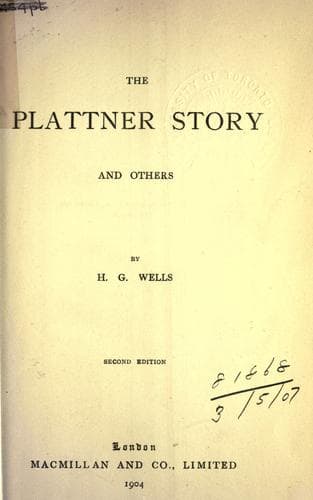
The Plattner Story, and OthersWells, H. G. (Herbert George)
Science
The Plattner Story, and Others
Wells, H. G. (Herbert George)
Great Britain -- Social life and customs -- Fiction; Science fiction; Short stories, English
The woman was quite dead, and having ascertained this, Pollock went to
the entrance of the hut and looked out. Things outside were dazzling
bright. Half a dozen of the porters of the expedition were standing up
in a group near the green huts they occupied, and staring towards him,
wondering what the shots might signify. Behind the little group of men
was the broad stretch of black fetid mud by the river, a green carpet
of rafts of papyrus and water-grass, and then the leaden water. The
mangroves beyond the stream loomed indistinctly through the blue haze.
There were no signs of excitement in the squat village, whose fence was
just visible above the cane-grass.
Pollock came out of the hut cautiously and walked towards the river,
looking over his shoulder at intervals. But the Porroh man had
vanished. Pollock clutched his revolver nervously in his hand.
One of his men came to meet him, and as he came, pointed to the bushes
behind the hut in which the Porroh man had disappeared. Pollock had
an irritating persuasion of having made an absolute fool of himself;
he felt bitter, savage, at the turn things had taken. At the same
time, he would have to tell Waterhouse--the moral, exemplary, cautious
Waterhouse--who would inevitably take the matter seriously. Pollock
cursed bitterly at his luck, at Waterhouse, and especially at the West
Coast of Africa. He felt consummately sick of the expedition. And
in the back of his mind all the time was a speculative doubt where
precisely within the visible horizon the Porroh man might be.
It is perhaps rather shocking, but he was not at all upset by the
murder that had just happened. He had seen so much brutality during the
last three months, so many dead women, burnt huts, drying skeletons, up
the Kittam River in the wake of the Sofa cavalry, that his senses were
blunted. What disturbed him was the persuasion that this business was
only beginning.
He swore savagely at the black, who ventured to ask a question, and
went on into the tent under the orange-trees where Waterhouse was
lying, feeling exasperatingly like a boy going into the headmaster's
study.
Waterhouse was still sleeping off the effects of his last dose of
chlorodyne, and Pollock sat down on a packing-case beside him, and,
lighting his pipe, waited for him to awake. About him were scattered
the pots and weapons Waterhouse had collected from the Mendi people,
and which he had been repacking for the canoe voyage to Sulyma.
Presently Waterhouse woke up, and after judicial stretching, decided
he was all right again. Pollock got him some tea. Over the tea the
incidents of the afternoon were described by Pollock, after some
preliminary beating about the bush. Waterhouse took the matter even
more seriously than Pollock had anticipated. He did not simply
disapprove, he scolded, he insulted.
Public-domain text, read in full here on John Shaqi.
Reviews
Reviews
No reviews yet
Be the first to share your thoughts on this work.
Elsewhere in the archive
Join the Discussion
Join the discussion
Sign in to leave a comment or review.
Sign InorCreate an account