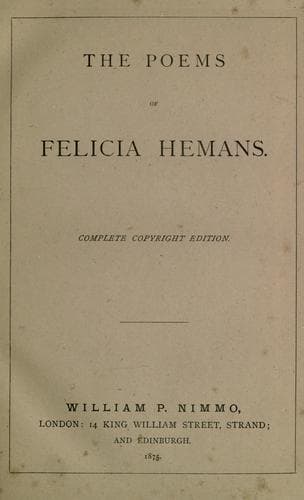
_Edinburgh Monthly Review._--“We have on more than one occasion
expressed the very high opinion which we entertain of the talents of
this lady; and it is gratifying to find that she gives us no reason
to retract or modify in any degree the applause already bestowed, and
that every fresh exhibition of her powers enhances and confirms her
claims upon our admiration. Mrs Hemans is indeed but in the infancy of
her poetical career; but it is an infancy of unrivalled beauty, and of
very high promise. Not but that she has already performed more than
has often been sufficient to win for other candidates no mean place in
the roll of fame, but because what she has already done shrinks, when
compared with what we consider to be her own great capacity, to mere
incipient excellence--the intimation rather than the fulfilment of the
high destiny of her genius.
... “The verses of Mrs Hemans appear the spontaneous offspring of
intense and noble feeling, governed by a clear understanding, and
fashioned into elegance by an exquisite delicacy and precision of
taste. With more than the force of many of her masculine competitors,
she never ceases to be strictly _feminine_ in the whole current of
her thought and feeling, nor approaches by any chance the verge of
that free and intrepid course of speculation, of which the boldness
is more conspicuous than the wisdom, but into which some of the most
remarkable among the female literati of our times have freely and
fearlessly plunged. She has, in the poem before us, made choice of a
subject of which it would have been very difficult to have reconciled
the treatment, in the hands of some female authors, to the delicacy
which belongs to the sex, and the tenderness and enthusiasm which
form its finest characteristics. A coarse and chilling cento of
the exploded fancies of modern scepticism, done into rhyme by the
hand of a woman, would have been doubly disgusting, by the revival
of absurdities long consigned to oblivion, and by the revolting
exhibition of a female mind shorn of all its attractions, and wrapt
in darkness and defiance. But Mrs Hemans has chosen the better and
the nobler cause, and, while she has left in the poem before us every
trace of vigorous intellect of which the subject admitted, and has far
transcended in energy of thought the prosing pioneers of unbelief,
she has sustained throughout a tone of warm and confiding piety, and
has thus proved that the humility of hope and of faith has in it none
of the weakness with which it has been charged by the arrogance of
impiety, but owns a divine and mysterious vigour residing under the
very aspect of gentleness and devotion.”
Public-domain text, read in full here on John Shaqi.
Reviews
Reviews
No reviews yet
Be the first to share your thoughts on this work.
Elsewhere in the archive
Join the Discussion
Join the discussion
Sign in to leave a comment or review.
Sign InorCreate an account