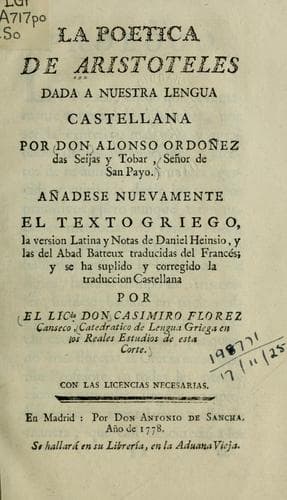
Aesthetics -- Early works to 1800; Poetry -- Early works to 1800
There are four kinds of Tragedy, the Complex, depending entirely on
Reversal of the Situation and Recognition; the Pathetic (where the
motive is passion),--such as the tragedies on Ajax and Ixion; the
Ethical (where the motives are ethical),--such as the Phthiotides and
the Peleus. The fourth kind is the Simple <We here exclude the purely
spectacular element>, exemplified by the Phorcides, the Prometheus, and
scenes laid in Hades. The poet should endeavour, if possible, to combine
all poetic elements; or failing that, the greatest number and those the
most important; the more so, in face of the cavilling criticism of the
day. For whereas there have hitherto been good poets, each in his own
branch, the critics now expect one man to surpass all others in their
several lines of excellence.
In speaking of a tragedy as the same or different, the best test to take
is the plot. Identity exists where the Complication and Unravelling are
the same. Many poets tie the knot well, but unravel it ill. Both arts,
however, should always be mastered.
Again, the poet should remember what has been often said, and not make
an Epic structure into a Tragedy--by an Epic structure I mean one with
a multiplicity of plots--as if, for instance, you were to make a tragedy
out of the entire story of the Iliad. In the Epic poem, owing to its
length, each part assumes its proper magnitude. In the drama the result
is far from answering to the poet's expectation. The proof is that the
poets who have dramatised the whole story of the Fall of Troy, instead
of selecting portions, like Euripides; or who have taken the whole
tale of Niobe, and not a part of her story, like Aeschylus, either fail
utterly or meet with poor success on the stage. Even Agathon has been
known to fail from this one defect. In his Reversals of the Situation,
however, he shows a marvellous skill in the effort to hit the popular
taste,--to produce a tragic effect that satisfies the moral sense. This
effect is produced when the clever rogue, like Sisyphus, is outwitted,
or the brave villain defeated. Such an event is probable in Agathon's
sense of the word: 'it is probable,' he says, 'that many things should
happen contrary to probability.'
The Chorus too should be regarded as one of the actors; it should be an
integral part of the whole, and share in the action, in the manner not
of Euripides but of Sophocles. As for the later poets, their choral
songs pertain as little to the subject of the piece as to that of any
other tragedy. They are, therefore, sung as mere interludes, a practice
first begun by Agathon. Yet what difference is there between introducing
such choral interludes, and transferring a speech, or even a whole act,
from one play to another?
XIX
Public-domain text, read in full here on John Shaqi.
Reviews
Reviews
No reviews yet
Be the first to share your thoughts on this work.
Join the Discussion
Join the discussion
Sign in to leave a comment or review.
Sign InorCreate an account