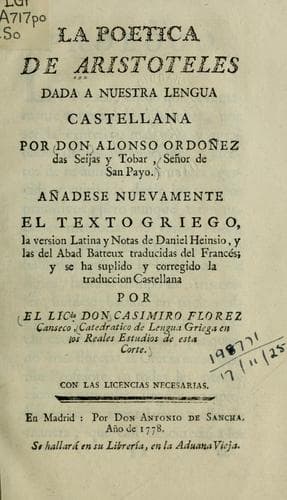
Aesthetics -- Early works to 1800; Poetry -- Early works to 1800
A Connecting word is a non-significant sound, which neither causes nor
hinders the union of many sounds into one significant sound; it may
be placed at either end or in the middle of a sentence. Or, a
non-significant sound, which out of several sounds, each of them
significant, is capable of forming one significant sound,--as {alpha mu
theta iota}, {pi epsilon rho iota}, and the like. Or, a non-significant
sound, which marks the beginning, end, or division of a sentence; such,
however, that it cannot correctly stand by itself at the beginning of a
sentence, as {mu epsilon nu}, {eta tau omicron iota}, {delta epsilon}.
A Noun is a composite significant sound, not marking time, of which no
part is in itself significant: for in double or compound words we do not
employ the separate parts as if each were in itself significant. Thus
in Theodorus, 'god-given,' the {delta omega rho omicron nu} or 'gift' is
not in itself significant.
A Verb is a composite significant sound, marking time, in which, as in
the noun, no part is in itself significant. For 'man,' or 'white' does
not express the idea of 'when'; but 'he walks,' or 'he has walked' does
connote time, present or past.
Inflexion belongs both to the noun and verb, and expresses either the
relation 'of,' 'to,' or the like; or that of number, whether one or
many, as 'man' or 'men '; or the modes or tones in actual delivery, e.g.
a question or a command. 'Did he go?' and 'go' are verbal inflexions of
this kind.
A Sentence or Phrase is a composite significant sound, some at least of
whose parts are in themselves significant; for not every such group
of words consists of verbs and nouns--'the definition of man,' for
example--but it may dispense even with the verb. Still it will always
have some significant part, as 'in walking,' or 'Cleon son of Cleon.' A
sentence or phrase may form a unity in two ways,--either as signifying
one thing, or as consisting of several parts linked together. Thus the
Iliad is one by the linking together of parts, the definition of man by
the unity of the thing signified.]
XXI
Words are of two kinds, simple and double. By simple I mean those
composed of non-significant elements, such as {gamma eta}. By double
or compound, those composed either of a significant and non-significant
element (though within the whole word no element is significant), or
of elements that are both significant. A word may likewise be triple,
quadruple, or multiple in form, like so many Massilian expressions, e.g.
'Hermo-caico-xanthus who prayed to Father Zeus>.'
Every word is either current, or strange, or metaphorical, or
ornamental, or newly-coined, or lengthened, or contracted, or altered.
Public-domain text, read in full here on John Shaqi.
Reviews
Reviews
No reviews yet
Be the first to share your thoughts on this work.
Join the Discussion
Join the discussion
Sign in to leave a comment or review.
Sign InorCreate an account