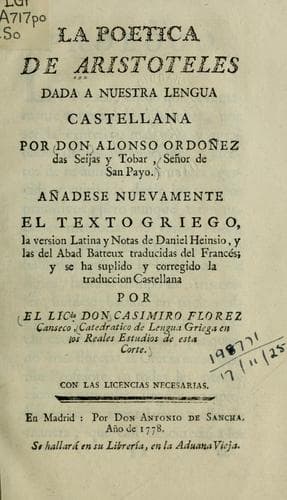
Aesthetics -- Early works to 1800; Poetry -- Early works to 1800
Of the various kinds of words, the compound are best adapted to
Dithyrambs, rare words to heroic poetry, metaphors to iambic. In heroic
poetry, indeed, all these varieties are serviceable. But in iambic
verse, which reproduces, as far as may be, familiar speech, the most
appropriate words are those which are found even in prose. These
are,--the current or proper, the metaphorical, the ornamental.
Concerning Tragedy and imitation by means of action this may suffice.
XXIII
As to that poetic imitation which is narrative in form and employs
a single metre, the plot manifestly ought, as in a tragedy, to be
constructed on dramatic principles. It should have for its subject a
single action, whole and complete, with a beginning, a middle, and
an end. It will thus resemble a living organism in all its unity, and
produce the pleasure proper to it. It will differ in structure from
historical compositions, which of necessity present not a single action,
but a single period, and all that happened within that period to one
person or to many, little connected together as the events may be. For
as the sea-fight at Salamis and the battle with the Carthaginians in
Sicily took place at the same time, but did not tend to any one result,
so in the sequence of events, one thing sometimes follows another, and
yet no single result is thereby produced. Such is the practice, we may
say, of most poets. Here again, then, as has been already observed, the
transcendent excellence of Homer is manifest. He never attempts to make
the whole war of Troy the subject of his poem, though that war had
a beginning and an end. It would have been too vast a theme, and not
easily embraced in a single view. If, again, he had kept it within
moderate limits, it must have been over-complicated by the variety of
the incidents. As it is, he detaches a single portion, and admits as
episodes many events from the general story of the war--such as the
Catalogue of the ships and others--thus diversifying the poem. All other
poets take a single hero, a single period, or an action single indeed,
but with a multiplicity of parts. Thus did the author of the Cypria
and of the Little Iliad. For this reason the Iliad and the Odyssey
each furnish the subject of one tragedy, or, at most, of two; while the
Cypria supplies materials for many, and the Little Iliad for eight--the
Award of the Arms, the Philoctetes, the Neoptolemus, the Eurypylus, the
Mendicant Odysseus, the Laconian Women, the Fall of Ilium, the Departure
of the Fleet.
XXIV
Public-domain text, read in full here on John Shaqi.
Reviews
Reviews
No reviews yet
Be the first to share your thoughts on this work.
Join the Discussion
Join the discussion
Sign in to leave a comment or review.
Sign InorCreate an account