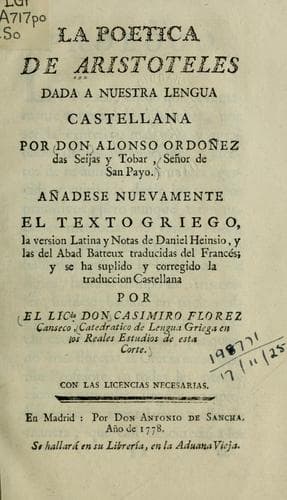
Aesthetics -- Early works to 1800; Poetry -- Early works to 1800
Homer, admirable in all respects, has the special merit of being the
only poet who rightly appreciates the part he should take himself. The
poet should speak as little as possible in his own person, for it is not
this that makes him an imitator. Other poets appear themselves upon the
scene throughout, and imitate but little and rarely. Homer, after a few
prefatory words, at once brings in a man, or woman, or other personage;
none of them wanting in characteristic qualities, but each with a
character of his own.
The element of the wonderful is required in Tragedy. The irrational, on
which the wonderful depends for its chief effects, has wider scope in
Epic poetry, because there the person acting is not seen. Thus, the
pursuit of Hector would be ludicrous if placed upon the stage--the
Greeks standing still and not joining in the pursuit, and Achilles
waving them back. But in the Epic poem the absurdity passes unnoticed.
Now the wonderful is pleasing: as may be inferred from the fact that
every one tells a story with some addition of his own, knowing that his
hearers like it. It is Homer who has chiefly taught other poets the
art of telling lies skilfully. The secret of it lies in a fallacy, For,
assuming that if one thing is or becomes, a second is or becomes, men
imagine that, if the second is, the first likewise is or becomes. But
this is a false inference. Hence, where the first thing is untrue, it is
quite unnecessary, provided the second be true, to add that the first
is or has become. For the mind, knowing the second to be true, falsely
infers the truth of the first. There is an example of this in the Bath
Scene of the Odyssey.
Accordingly, the poet should prefer probable impossibilities to
improbable possibilities. The tragic plot must not be composed of
irrational parts. Everything irrational should, if possible, be
excluded; or, at all events, it should lie outside the action of the
play (as, in the Oedipus, the hero's ignorance as to the manner of
Laius' death); not within the drama,--as in the Electra, the messenger's
account of the Pythian games; or, as in the Mysians, the man who
has come from Tegea to Mysia and is still speechless. The plea that
otherwise the plot would have been ruined, is ridiculous; such a plot
should not in the first instance be constructed. But once the irrational
has been introduced and an air of likelihood imparted to it, we must
accept it in spite of the absurdity. Take even the irrational incidents
in the Odyssey, where Odysseus is left upon the shore of Ithaca. How
intolerable even these might have been would be apparent if an inferior
poet were to treat the subject. As it is, the absurdity is veiled by the
poetic charm with which the poet invests it.
The diction should be elaborated in the pauses of the action, where
there is no expression of character or thought. For, conversely,
character and thought are merely obscured by a diction that is over
brilliant.
XXV
Public-domain text, read in full here on John Shaqi.
Reviews
Reviews
No reviews yet
Be the first to share your thoughts on this work.
Join the Discussion
Join the discussion
Sign in to leave a comment or review.
Sign InorCreate an account