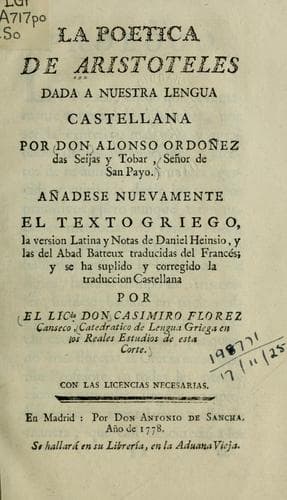
Aesthetics -- Early works to 1800; Poetry -- Early works to 1800
These, then, as we said at the beginning, are the three differences
which distinguish artistic imitation,--the medium, the objects, and the
manner. So that from one point of view, Sophocles is an imitator of the
same kind as Homer--for both imitate higher types of character; from
another point of view, of the same kind as Aristophanes--for both
imitate persons acting and doing. Hence, some say, the name of 'drama'
is given to such poems, as representing action. For the same reason the
Dorians claim the invention both of Tragedy and Comedy. The claim to
Comedy is put forward by the Megarians,--not only by those of Greece
proper, who allege that it originated under their democracy, but also
by the Megarians of Sicily, for the poet Epicharmus, who is much earlier
than Chionides and Magnes, belonged to that country. Tragedy too is
claimed by certain Dorians of the Peloponnese. In each case they appeal
to the evidence of language. The outlying villages, they say, are by
them called {kappa omega mu alpha iota}, by the Athenians {delta eta
mu iota}: and they assume that Comedians were so named not from {kappa
omega mu 'alpha zeta epsilon iota nu}, 'to revel,' but because they
wandered from village to village (kappa alpha tau alpha / kappa omega mu
alpha sigma), being excluded contemptuously from the city. They add
also that the Dorian word for 'doing' is {delta rho alpha nu}, and the
Athenian, {pi rho alpha tau tau epsilon iota nu}.
This may suffice as to the number and nature of the various modes of
imitation.
IV
Poetry in general seems to have sprung from two causes, each of them
lying deep in our nature. First, the instinct of imitation is implanted
in man from childhood, one difference between him and other animals
being that he is the most imitative of living creatures, and through
imitation learns his earliest lessons; and no less universal is the
pleasure felt in things imitated. We have evidence of this in the facts
of experience. Objects which in themselves we view with pain, we delight
to contemplate when reproduced with minute fidelity: such as the forms
of the most ignoble animals and of dead bodies. The cause of this again
is, that to learn gives the liveliest pleasure, not only to philosophers
but to men in general; whose capacity, however, of learning is more
limited. Thus the reason why men enjoy seeing a likeness is, that in
contemplating it they find themselves learning or inferring, and saying
perhaps, 'Ah, that is he.' For if you happen not to have seen the
original, the pleasure will be due not to the imitation as such, but to
the execution, the colouring, or some such other cause.
Imitation, then, is one instinct of our nature. Next, there is the
instinct for 'harmony' and rhythm, metres being manifestly sections of
rhythm. Persons, therefore, starting with this natural gift developed
by degrees their special aptitudes, till their rude improvisations gave
birth to Poetry.
Public-domain text, read in full here on John Shaqi.
Reviews
Reviews
No reviews yet
Be the first to share your thoughts on this work.
Join the Discussion
Join the discussion
Sign in to leave a comment or review.
Sign InorCreate an account