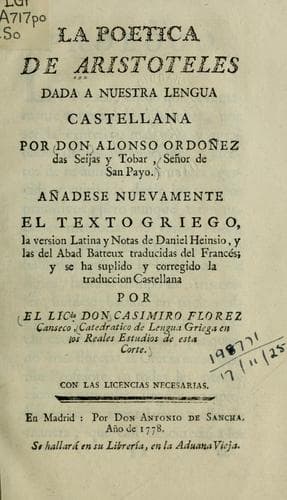
Aesthetics -- Early works to 1800; Poetry -- Early works to 1800
But most important of all is the structure of the incidents. For Tragedy
is an imitation, not of men, but of an action and of life, and life
consists in action, and its end is a mode of action, not a quality. Now
character determines men's qualities, but it is by their actions that
they are happy or the reverse. Dramatic action, therefore, is not with
a view to the representation of character: character comes in as
subsidiary to the actions. Hence the incidents and the plot are the
end of a tragedy; and the end is the chief thing of all. Again, without
action there cannot be a tragedy; there may be without character.
The tragedies of most of our modern poets fail in the rendering of
character; and of poets in general this is often true. It is the same
in painting; and here lies the difference between Zeuxis and Polygnotus.
Polygnotus delineates character well: the style of Zeuxis is devoid
of ethical quality. Again, if you string together a set of speeches
expressive of character, and well finished in point of diction and
thought, you will not produce the essential tragic effect nearly so well
as with a play which, however deficient in these respects, yet has a
plot and artistically constructed incidents. Besides which, the most
powerful elements of emotional: interest in Tragedy Peripeteia or
Reversal of the Situation, and Recognition scenes--are parts of the
plot. A further proof is, that novices in the art attain to finish: of
diction and precision of portraiture before they can construct the plot.
It is the same with almost all the early poets.
The Plot, then, is the first principle, and, as it were, the soul of
a tragedy: Character holds the second place. A similar fact is seen in
painting. The most beautiful colours, laid on confusedly, will not give
as much pleasure as the chalk outline of a portrait. Thus Tragedy is
the imitation of an action, and of the agents mainly with a view to the
action.
Third in order is Thought,--that is, the faculty of saying what is
possible and pertinent in given circumstances. In the case of oratory,
this is the function of the Political art and of the art of rhetoric:
and so indeed the older poets make their characters speak the language
of civic life; the poets of our time, the language of the rhetoricians.
Character is that which reveals moral purpose, showing what kind of
things a man chooses or avoids. Speeches, therefore, which do not make
this manifest, or in which the speaker does not choose or avoid anything
whatever, are not expressive of character. Thought, on the other hand,
is found where something is proved to be, or not to be, or a general
maxim is enunciated.
Fourth among the elements enumerated comes Diction; by which I mean, as
has been already said, the expression of the meaning in words; and its
essence is the same both in verse and prose.
Of the remaining elements Song holds the chief place among the
embellishments.
Public-domain text, read in full here on John Shaqi.
Reviews
Reviews
No reviews yet
Be the first to share your thoughts on this work.
Join the Discussion
Join the discussion
Sign in to leave a comment or review.
Sign InorCreate an account